
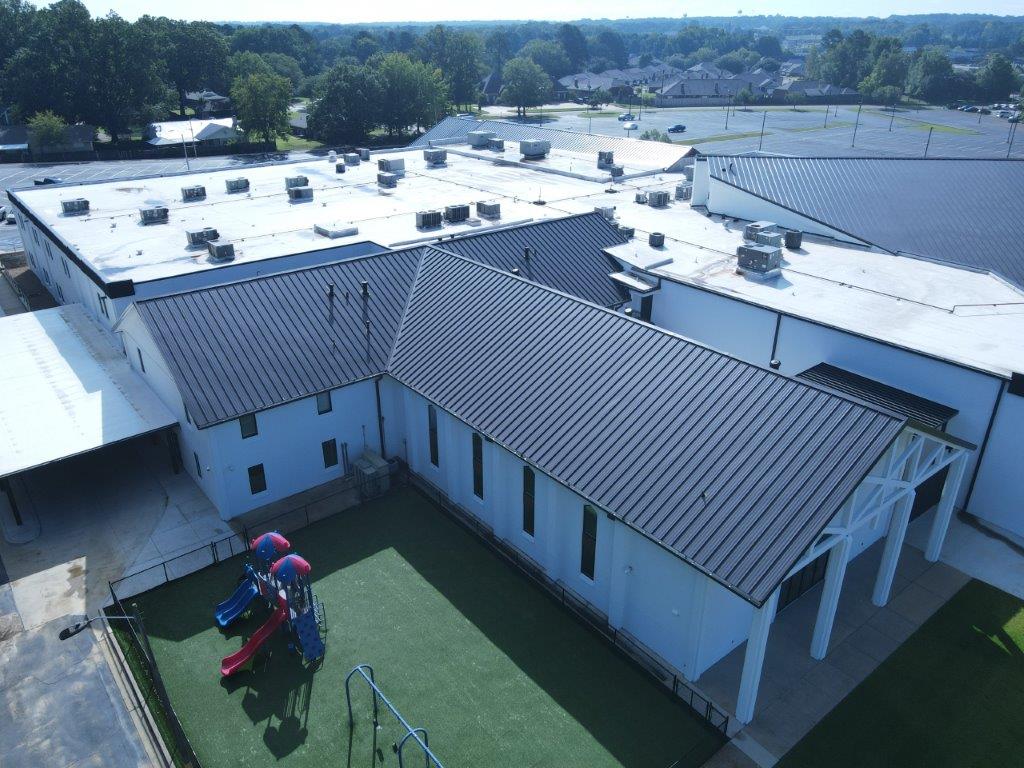
Religious Building Roofing in Austin, TX
Austin's religious building inventory spans modern multi-campus megachurch facilities with sanctuary buildings in the 50,000 sq ft range, historic downtown sanctuaries, and suburban worship campuses built in multiple phases over decades. Each type presents distinct roofing challenges.
Austin's religious building stock is more varied than most cities its size. The city has a cluster of historically significant downtown sanctuaries, some dating to the late 1800s, with complex pitched and flat roof assemblies on masonry construction that require a different approach than standard commercial flat-roof work. At the other end of the spectrum, several Austin-area megachurch campuses have built modern facilities in the 40,000 to 100,000 sq ft sanctuary range, with large-span flat or low-slope roofs over worship halls, school buildings, and administrative wings.
Religious facilities have a specific operating constraint: they are used intensively on weekends and intermittently during the week. A roof failure on a Thursday is a crisis by Sunday. Weekend services bring hundreds or thousands of people into a building, a leak above a sanctuary during a Sunday morning service is not just a property damage event, it is a safety and liability event. We approach religious facility scopes with the weekend service schedule as the primary scheduling constraint.
Budget structure also differs. Most religious organizations do not maintain a large capital reserve fund earmarked for roof replacement, the capital campaign model means a full replacement often requires advance planning of 12 to 18 months. We can work within that timeline: deliver a detailed written scope and cost estimate 12 months before the intended project start, assist with the documentation the building committee needs for a capital campaign, and hold the price for an agreed period.
Modern Megachurch and Multi-Building Campus Roofing
Austin's suburban megachurch campuses, similar in scale to the Houston-area facilities that set the regional benchmark for large congregational buildings, have sanctuary buildings with large-span steel roof structures carrying TPO or standing-seam metal roofing over worship halls, and adjacent flat-roof wings housing school, administrative, and fellowship space. The worship hall roof is the highest-consequence section: a failure there affects the primary congregation space, which is occupied by the largest number of people.
Large-span roofs over worship halls present structural load considerations that differ from standard commercial buildings. Long-span steel joists have more deflection than short-span framing, the roof membrane and insulation system must accommodate this movement without membrane fatigue at the seam locations. We specify membrane systems and attachment patterns appropriate for long-span framing conditions, not standard commercial framing assumptions.
Multi-building campuses developed in phases over 10 to 20 years have roofs in different condition states. The original sanctuary may have a 20-year-old BUR system while the newer education wing has a 10-year-old TPO system. We assess each section independently and deliver a capital replacement schedule ranked by condition and urgency, a useful document for any building committee planning a multi-year roofing program.
Austin's historic downtown churches, several on the National Register of Historic Places or contributing to the Congress Avenue historic district, have masonry construction with a mix of pitched slate or clay tile roofing and flat-roof sections over fellowship halls, Sunday school wings, and other additions built in the 20th century. The flat-roof sections on historic sanctuaries are often the leak source: they were added with less permanence in mind than the original sanctuary construction and have been maintained reactively for decades.
Working on historic buildings requires awareness of what can and cannot be changed. Roof replacement on a flat-roof addition to a historic sanctuary does not typically trigger landmark review, the addition is not the contributing historic element. But parapet modifications, penetration additions, or any work visible from the public right of way may require coordination with the City of Austin Historic Landmark Commission. We flag these requirements during the scope walk.
Scheduling Around Services and Events
Religious facilities have weekly service schedules plus irregular events, including Thanksgiving, Christmas, Easter, special services, weddings, and funerals, that create gaps in the production calendar. We plan the project schedule around the service calendar from the start, not as an adjustment made mid-project. The facility coordinator provides the event calendar before we finalize the production schedule, and we identify blackout dates where no tear-off or loud work will be conducted.
Weekday production, typically Monday through Thursday, is the standard window for most religious facility roofing projects. Friday and Saturday preparation activity is scheduled for non-disruptive tasks: material staging, layout, pre-manufactured flashing delivery. Tear-off is never scheduled on a Friday or Saturday when there is any possibility that a weather delay could leave the building exposed going into a Sunday service.
Can you work around our weekend service schedule?
Yes, that is the default plan, not an accommodation. We schedule tear-off and production for weekday windows only. The project schedule is built from your service calendar. We do not schedule loud or disruptive work on days when the building will be occupied by a congregation, and we do not leave open sections going into a weekend.
Our congregation is planning a capital campaign for the roof. Can you help with the documentation?
We can deliver a detailed written scope and cost estimate that serves as the capital campaign documentation, a cover page summary, a written specification, zone photography, and a line-item cost breakdown. We can also provide a simple written explanation of the roofing work for a building committee audience that does not have construction background. Price holds for a defined period can be structured into the contract.
Our church has a sanctuary with a long-span roof. Are there special structural considerations?
Long-span steel joists deflect more than standard commercial framing and require membrane attachment patterns and seam placement that account for this movement. We assess the structural drawings or consult with a structural engineer if we have concerns about deflection-related membrane fatigue at specific locations. This is a scope walk item, not a discovery mid-project.
Schedule a religious facility roof assessment in Austin.
We work with modern campus facilities, historic downtown sanctuaries, and suburban worship buildings across Travis County. Assessments include a condition report with capital replacement documentation suitable for building committee review.
Leak points, drainage, seams, penetrations, edge metal, roof access, and interior risk should be clear before the next roof decision is priced.
Immediate repair, maintenance, coating, recover, and replacement choices should be measured against roof age, moisture risk, tenant disruption, and budget timing.
A site visit is useful when the owner needs a documented roof condition, active leak response, storm review, or a clearer capital plan.