
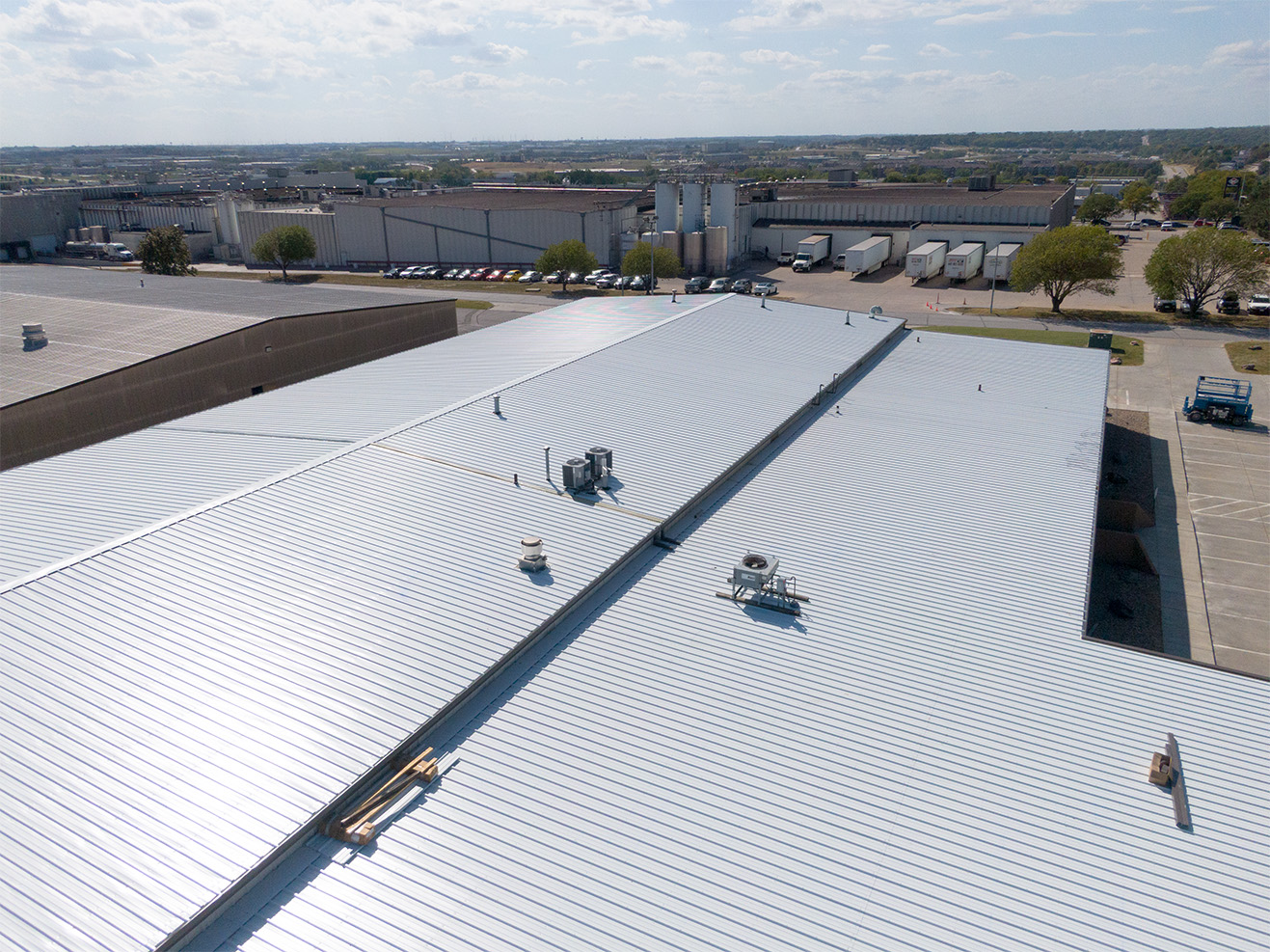
Standing Seam Metal Roof Systems in Austin, TX
Standing seam metal roofing is the architectural specification choice for Austin commercial buildings where the Hill Country vernacular matters, office campuses in the cedar-and-limestone submarket west of MoPac, hospitality properties in the Barton Creek corridor, and mixed-use developments where roofline is part of the building identity.
The Hill Country influence on Austin commercial architecture is real and persistent. The visual language of the Texas Hill Country, limestone cladding, metal rooflines, cedar accents, shows up in office campuses west of MoPac on the Barton Creek corridor, in hospitality properties along FM 2222 and RR 620, and in the mixed-use developments in the Bee Cave and Lakeway markets that function as Austin's western suburban edge. Standing seam metal roofing is the specification that delivers that aesthetic in a system that performs in Central Texas's UV-intensive, thermally demanding climate.
Standing seam metal is also the specification that commercial solar integrators want under a photovoltaic array. The concealed clip attachment system allows solar panels to be mounted without roof penetrations, rails attach to the seam clips directly, eliminating the leak risk of penetration-mounted systems. With Austin Energy's commercial solar programs and the federal ITC still driving commercial solar adoption in the Austin MSA, standing seam metal is increasingly the roofing specification choice for commercial building owners who intend to add solar.
The performance case for standing seam metal in Austin goes beyond aesthetics and solar readiness. A properly installed Kynar-coated or PVDF-finished metal roof system carries a 40-year material warranty from most major manufacturers. Metal does not require the membrane replacement cycle that single-ply systems do. The long-term capital cost of metal roofing on a building that will be held for 30-plus years is often lower than the cumulative cost of two TPO replacement cycles over the same period.
System Selection: Panel Profile, Clip, and Finish
Standing seam profiles range from 1-inch to 3-inch seam heights in snap-lock and structural configurations. Structural standing seam, where the seam is mechanically seamed with a dedicated tool rather than snapped, is the specification for low-slope commercial applications where the panel must carry snow load or where the slope is under 1:12. In Austin, where meaningful snow load is rare, snap-lock panels are appropriate for most applications with slopes above 3:12; structural seam is specified for lower slopes or for buildings in the path of the documented ice storm events that Austin sees every several years.
The concealed clip is the attachment mechanism that distinguishes standing seam from exposed-fastener metal roofing. Clips float between the panel and the deck framing, allowing the panel to expand and contract thermally without stressing the attachment point. On an Austin building where panel surface temperature swings from 40°F in a January ice event to 165°F in an August peak, that thermal movement is significant, an estimated 1 inch of expansion per 100 linear feet on a galvalume panel across that temperature range. A properly designed clip system accommodates that movement without oil-canning or seam distortion.
Finish selection, Kynar 500 or PVDF fluoropolymer coating, determines color retention and chalk resistance over the life of the system. Austin's UV index is high enough that color-fast coatings matter; standard polyester finishes show measurable color shift within 10 years in Central Texas sun exposure. Kynar 500 is the 40-year finish benchmark and is standard on most commercial-grade standing seam specified for Austin applications.
Installation on Austin Commercial Buildings
The substrate for commercial standing seam is typically a structural steel subframing system over the primary structure, or purlins on pre-engineered metal building applications. On occupied commercial buildings being re-roofed from a flat system to standing seam, the structural design requires engineering review, the new framing system must be designed against the existing building's structural capacity and the wind-uplift requirements for the Austin site.
Panel run length matters in Austin's thermal environment. Longer panels mean more thermal movement per panel. For panels over 50 feet in length, we specify floating clip patterns with slip-zone allowances at the fixed end. For buildings in the western Austin Hill Country submarket where the topography creates localized wind acceleration effects, particularly on ridge-top sites along the Barton Creek or Lake Travis corridors, wind-uplift calculations are conserved.
Trim and flashing details on standing seam, ridge cap, eave trim, gable trim, and penetration flashings, are fabricated from the same metal as the field panel to ensure color consistency and compatible thermal behavior. Incompatible dissimilar metals at trim connections create galvanic corrosion; we specify compatible metal throughout the system and document every dissimilar metal interface with appropriate sealant or isolator.
Standing Seam for Solar-Ready Austin Commercial Buildings
The concealed clip that gives standing seam its thermal performance also provides the mounting point for solar rail attachment without roof penetrations. Solar rail brackets clamp to the seam, transferring the panel and rail load directly to the clip-and-framing assembly. For Austin commercial building owners planning solar installation concurrent with or after roofing, the structural framing design should account for the added dead load and wind load from the solar panel array at the initial framing design stage, retrofitting for solar load after the framing is installed can require additional engineering and structural modification.
Austin Energy's commercial solar programs and the federal Investment Tax Credit have made commercial solar economics increasingly favorable for Austin building owners with suitable roof areas. We coordinate with the solar contractor on framing layout and clip placement to ensure the solar mounting pattern is compatible with the standing seam panel system. Getting the roofing contractor and the solar contractor aligned before installation starts avoids conflicts that are expensive to resolve in the field.
For Hill Country commercial properties west of Austin, Bee Cave, Lakeway, Dripping Springs, the combination of standing seam metal roofing with integrated solar is a consistent specification for new commercial construction and retrofit. The aesthetic fits the vernacular, the performance in the UV-intensive Central Texas environment is proven, and the solar integration avoids the roof penetrations that would otherwise compromise a 40-year system.
Is standing seam metal appropriate for low-slope or flat commercial roofs in Austin?
Structural standing seam can be installed on slopes as low as 1/4:12 with appropriate seam configuration and underlayment. However, at very low slopes, a single-ply membrane system is typically a lower-cost and equally reliable specification. Standing seam is most cost-effective on Austin commercial buildings where the slope is 1:12 or greater, which covers the majority of Hill Country and suburban commercial applications where the aesthetic case for metal roofing is strongest.
How does Austin's hail affect standing seam metal roofing?
Standing seam metal has better hail resistance than single-ply membrane roofing, but is not immune to cosmetic damage from large hailstones. Quarter-size hail at impact velocities common in Central Texas convective storms can produce visible denting in aluminum and some steel panels. Galvalume and thicker-gauge steel panels resist denting better than aluminum at comparable impact energy. If your building is in a documented hail-frequency corridor, northern Williamson County and the Round Rock to Pflugerville belt, we discuss gauge selection as part of the system specification.
What is the maintenance requirement for standing seam metal roofing?
Standing seam metal requires periodic inspection of seam integrity, trim and flashing sealant condition, and gutter and drain cleanliness. Annual inspection is the standard maintenance protocol. In Austin's cedar and oak-heavy western suburbs, debris accumulation in gutters and at panel laps is a more frequent maintenance item than in cleared commercial zones. The inspection interval for buildings under tree canopy should be semi-annual rather than annual for gutter and lap debris management.
Get a standing seam metal roof assessment or specification for your Austin commercial building.
If you are building or re-roofing in the Hill Country corridor, planning solar integration, or evaluating metal as a long-term capital alternative to repeated single-ply replacement, we can provide a written specification and project scope.
Leak points, drainage, seams, penetrations, edge metal, roof access, and interior risk should be clear before the next roof decision is priced.
Immediate repair, maintenance, coating, recover, and replacement choices should be measured against roof age, moisture risk, tenant disruption, and budget timing.
A site visit is useful when the owner needs a documented roof condition, active leak response, storm review, or a clearer capital plan.