
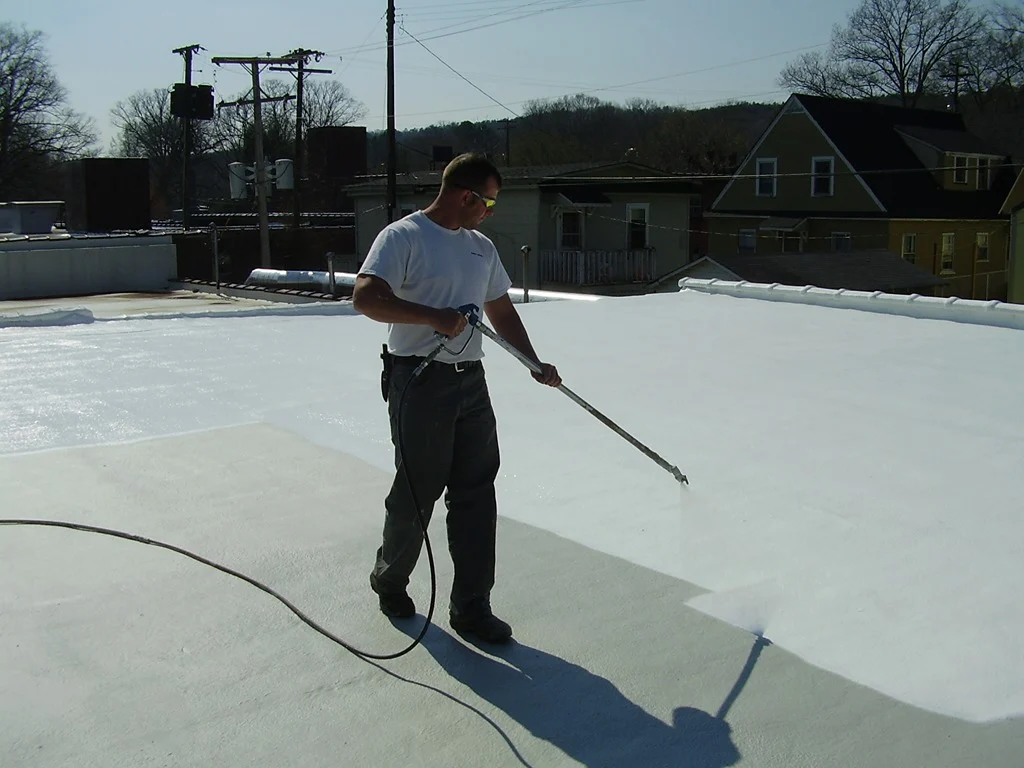
Spray Polyurethane Foam Roof Systems in Austin, TX
Spray polyurethane foam is a seamless roof system that combines insulation and waterproofing in a single applied layer. For Austin industrial buildings with complex rooftop geometry, numerous penetrations, or drainage slope challenges, SPF eliminates the seam failure paths that membrane systems carry.
Spray polyurethane foam is applied as a two-component liquid that expands and cures in place, it conforms to every surface contour, encapsulates penetrations, builds slope to drains in areas where the deck has no built-in slope, and produces a seamless insulating and waterproofing layer in one application. The system's main vulnerability is UV exposure, which degrades unprotected foam within 30 to 90 days of installation. The UV-protective layer, typically a silicone topcoat applied in two coats immediately after foam cure, is what makes SPF a long-term roofing system rather than an insulation experiment.
In Austin's industrial market, SPF finds its best applications on buildings with complex rooftop equipment geometry, multiple HVAC units, roof penetrations at irregular spacing, equipment curbs at varying heights, where the number of membrane flashing details on a conventional single-ply system multiplies leak risk. Foam encapsulates penetrations and curbs seamlessly; the flashing detail is built into the foam profile rather than fabricated and adhered separately. For Austin industrial buildings in the Del Valle corridor and the East Austin manufacturing clusters, where mechanical equipment density on older roofs is high, SPF can simplify the waterproofing geometry substantially.
SPF is also the specification of choice for Austin buildings with chronic ponding problems where the deck geometry cannot be modified to add slope. Foam can be applied at varying thickness across the roof field to build positive drainage to existing drains, eliminating ponding at specific locations by designing slope into the foam layer rather than through the tapered insulation approach used under single-ply membranes.
SPF Application Process and Austin Weather Constraints
Spray polyurethane foam is highly sensitive to application conditions. Substrate moisture content must be below a threshold that varies by product, we measure substrate moisture before application and postpone when readings are above acceptable levels. In Austin's spring rainy season, this means morning staging and flexibility to stand down if the roof surface has not dried from overnight dew or recent rain.
Ambient temperature and humidity affect foam cell formation. Too cold (below 50°F ambient), and the foam does not expand properly. Too humid, and cell structure becomes irregular. Austin's spring and fall conditions are generally favorable; summer heat requires morning application before substrate temperature drives ambient conditions above the upper application threshold for some product formulations. Our crews are equipped with temperature and humidity monitoring and apply only within the product-specific acceptable range.
The silicone topcoat goes on within the product-specified window after foam cure, typically within 24 to 72 hours of the foam application for most products. The silicone coat is applied in two passes to achieve the warranted dry film thickness. If the foam surface is damaged between foam application and topcoat (by rain, foot traffic, or UV exposure beyond the product window), the affected area must be repaired and primed before topcoat application.
SPF Insulation Value in Austin's Energy Code Environment
Spray polyurethane foam achieves R-6 to R-7 per inch of applied thickness, making it the highest R-value-per-inch insulation material used in commercial roofing. A 3-inch SPF application achieves R-18 to R-21; a 4-inch application achieves R-24 to R-28, placing it at or above IECC 2021 minimums for Austin low-slope commercial applications.
The seamless nature of SPF eliminates thermal bridging at fastener points, the primary insulation efficiency loss in mechanically fastened polyiso systems. On an Austin building with a large roof-to-floor-area ratio, the single-story industrial and warehouse buildings that make up most of the Del Valle and East Austin commercial inventory, the absence of thermal bridging can produce a meaningful difference in envelope performance relative to mechanically fastened insulation systems.
SPF's closed-cell structure also provides air barrier performance in addition to thermal insulation, it does not allow air infiltration at seams or fastener points because there are no seams or fastener points. For Austin industrial buildings where conditioned floor area is adjacent to large unconditioned loading dock areas, the air barrier benefit of SPF can reduce HVAC load in ways that standard insulation board assemblies do not.
SPF Maintenance and Recoat Cycle
The UV-protective silicone topcoat on an SPF system requires periodic inspection and, at intervals determined by original topcoat thickness and weathering rate, recoating to maintain UV protection over the foam layer. A well-specified and applied SPF system with a 20-mil or greater silicone topcoat typically requires recoat inspection at 10 to 15 years. If the topcoat has weathered to below the minimum thickness, a recoat with additional silicone restores UV protection without removing or replacing the foam layer.
This recoat cycle is a key economic feature of SPF for Austin building owners with long hold periods. A foam layer installed correctly, with the right cell density and topcoat, does not require removal and replacement at the end of the coating warranty. It requires recoating. The cumulative cost of an SPF system over 30 to 40 years, initial installation plus two recoat cycles, can be competitive with the cumulative cost of two full single-ply membrane replacement cycles over the same period.
Annual inspection is required to maintain most SPF system warranties. The inspection focuses on topcoat condition, mechanical damage from foot traffic or equipment maintenance, and the integrity of SPF at penetrations and edges where impact damage is most likely. Punctures or gouges in the foam that reach the substrate must be repaired before the next rain event, exposed foam absorbs water if the topcoat is breached.
How long does SPF last in Austin's UV environment?
The foam itself, once covered by a properly maintained silicone topcoat, can last 30 to 40 years. The silicone topcoat requires inspection and eventual recoating, the recoat interval depends on the original applied mil thickness and the weathering rate in Austin's UV environment, typically 12 to 18 years between recoats on a 20-mil-or-greater original topcoat. The foam layer is essentially permanent as long as the topcoat maintains UV protection.
Is SPF appropriate for Austin buildings with heavy mechanical traffic on the roof?
SPF is more vulnerable to mechanical damage than a thick single-ply membrane, concentrated point loads from equipment service personnel or dropped tools can gouge the foam surface. For buildings with frequent rooftop mechanical work, walk pads at all access routes are essential, and the inspection protocol should include a topcoat thickness check at equipment access areas annually. If mechanical traffic is very heavy and frequent, a single-ply membrane system may produce better long-term durability.
Can SPF be applied over an existing single-ply membrane?
In some cases yes, subject to manufacturer approval and substrate condition assessment. SPF applied over TPO or EPDM requires the existing membrane to be clean, dry, and adhered. Delaminated or blistered existing membrane is not an appropriate substrate, the foam adheres to the membrane, not to the insulation below it, and if the membrane is not adhered, the foam layer will fail with it. We assess the existing membrane condition before recommending SPF as a recover option.
Get an SPF roof system assessment for your Austin industrial building.
If your building has complex penetrations, drainage slope problems, or high insulation requirements, we can assess whether SPF produces better long-term performance than a conventional membrane system.
Leak points, drainage, seams, penetrations, edge metal, roof access, and interior risk should be clear before the next roof decision is priced.
Immediate repair, maintenance, coating, recover, and replacement choices should be measured against roof age, moisture risk, tenant disruption, and budget timing.
A site visit is useful when the owner needs a documented roof condition, active leak response, storm review, or a clearer capital plan.