
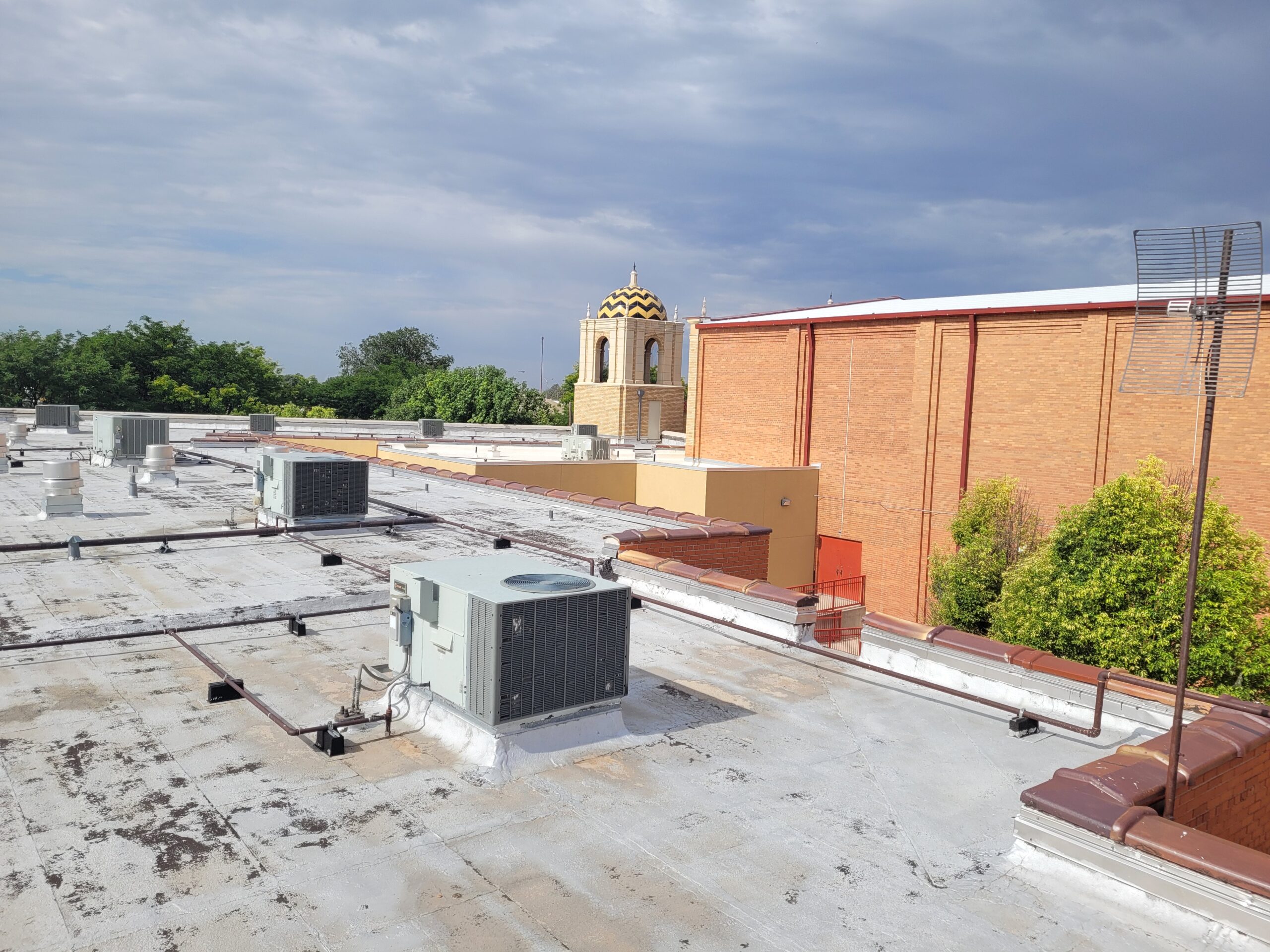
Roof Capital Planning in Austin, TX
A roof capital plan built from actual condition data, not manufacturer-average life expectancy applied to a building we have never walked. We inspect, document, and project replacement cost and timing for Austin commercial roofs based on what the roof actually is.
Roof capital planning for Austin commercial properties fails when it is built on assumptions rather than inspections. A building owner who knows their roof is 'about fifteen years old' and assumes a twenty-year expected life does not have a capital plan, they have a guess. When the roof fails at year thirteen because of accelerated UV degradation or a prior repair that was never properly closed out, the capital expenditure hits without a reserve.
Austin's climate makes condition-based planning more important than manufacturer life expectancy averages. UV index in Austin is meaningfully higher than the national average used in most manufacturer life-expectancy tables. Surface temperatures on dark or aging membranes in the 78701 to 78745 zip code corridors routinely hit 155–165°F in July and August, thermal cycling at those ranges accelerates membrane aging faster than the same system would age in a cooler market. A condition inspection tells you where the roof actually is in its life cycle; the manufacturer's average does not.
We build capital plans for individual Austin commercial buildings and for multi-building portfolios. The plan starts with a baseline inspection, produces a condition-based remaining service life estimate for each roof, translates that into a replacement year estimate with a replacement cost range, and schedules the capital outlay across the owner's planning horizon. For a portfolio owner planning a five-year capital reserve, that schedule is the financial model they need.
Building the Capital Projection
The projection starts with the inspection record. If we have performed a recent inspection, we use that data. If no current inspection exists, we perform a baseline walk before producing any projection, because a capital plan built on unverified assumptions is not a capital plan.
Remaining service life estimation accounts for membrane type, installation year, current condition observed at inspection, core sampling results where moisture intrusion is suspected, and Austin-specific climate factors. A 60-mil TPO installed in 2011 in the Domain corridor with clean cores, intact seams, and well-maintained penetration flashings has a different remaining service life than the same system in 2011 vintage with open lap seams and corroded drain covers. We differentiate.
Replacement cost estimates use current Austin market pricing for the membrane type and system configuration we would specify on that building today. We do not use national average cost per square foot; we use what we know about Austin labor and material costs, the permit fee schedules for the relevant municipality, City of Austin, Round Rock, Cedar Park, Pflugerville, and any building-specific logistics factors like downtown crane access or after-hours work requirements.
Multi-Year Portfolio Capital Schedule
For a portfolio of Austin commercial buildings, the capital schedule maps each building's projected replacement year against a shared capital horizon. The output tells the owner how much roof replacement capital they need in year one, year two, year three, and so on across the planning period. That schedule supports annual budget submissions, reserve fund management, lender conversations, and capital expenditure prioritization.
Austin's hail corridor adds a probabilistic element to capital scheduling. Buildings in northern Travis County and Williamson County have documented higher hail frequency than the city core. For buildings in those locations, we note the elevated risk in the capital schedule and recommend either an insurance review or a membrane specification upgrade at the next replacement cycle, 80-mil TPO with a manufacturer hail-resistance rating rather than standard 60-mil.
Capital schedules are updated annually as part of the ongoing asset management program. When a building's condition degrades faster than projected, after a storm event or after a prior repair is found to have failed, the schedule updates to reflect the new remaining service life. The owner always has a current projection, not one that was accurate two years ago and has not been revisited.
Capital Planning for Transactions
Commercial real estate transactions in Austin, acquisitions, refinancings, and sale-leaseback structures, frequently require roof capital reserve documentation as part of the lender's or buyer's due diligence package. A capital plan prepared to lender standards documents the current condition, the projected replacement timeline, and the capital reserve required to cover replacement without a reserve shortfall during the loan term or investment hold period.
We prepare capital reserve documentation for Austin properties in formats compatible with most institutional lender requirements. The document includes the inspection summary, remaining service life estimate, replacement year projection, and replacement cost range in a format that a lender's underwriter can read without being a roofing expert. For East Austin and South Congress properties moving through the active Austin investment market, we can often turn this documentation around within ten business days of the site visit.
How accurate are commercial roof replacement cost estimates in the Austin market?
Our estimates use current Austin-area labor and material pricing and are updated quarterly. For a standard 50,000 sq ft TPO replacement in the Austin metro, we can provide a cost range accurate to within 10 to 15% before we have completed a full scope walk. After the scope walk and core sampling, the estimate narrows. Actual bids come after the scope is finalized, but the capital plan estimate is accurate enough for reserve scheduling and lender conversations.
Can a capital plan be built without a current inspection?
We will not build a capital projection without walking the roof. A schedule built on age alone, without condition data, is not useful, it will either overstate the urgency (the roof is older than average but in above-average condition) or understate it (the roof is newer but has undetected moisture damage). The inspection is the foundation of a credible plan.
How do you account for Austin's inflation in construction costs when projecting replacement costs?
We apply an annual escalation factor to out-year replacement cost estimates, typically 3 to 5% per year for Austin, reflecting the documented cost escalation in the Central Texas construction market. For planning purposes, a building projected to need replacement in year seven carries a higher cost estimate than the same project executed today. Lenders and CFOs generally want to see escalated out-year costs, not today's dollar figures applied to a future date.
Build a roof capital plan for your Austin property.
We perform the inspection, document the condition, and deliver a capital schedule you can use for budgeting, lender conversations, or portfolio reserve management.
Leak points, drainage, seams, penetrations, edge metal, roof access, and interior risk should be clear before the next roof decision is priced.
Immediate repair, maintenance, coating, recover, and replacement choices should be measured against roof age, moisture risk, tenant disruption, and budget timing.
A site visit is useful when the owner needs a documented roof condition, active leak response, storm review, or a clearer capital plan.