
Commercial Roofing, TX
Commercial roofers serving Austin, TX should document leak sources, wet insulation, drainage, edge details, penetrations, and repair history before recommending a scope. Austin's commercial real estate inventory expanded dramatically in the decade between 2014 and 2024, spec office, Class A mid-rise, mixed-use ground floor, and light industrial all added to the Travis County tax roll faster than in almost any other MSA in the country. That growth means a large portion of Austin's commercial roof inventory was installed between 2012 and 2022 and is now approaching the maintenance decision point. We are positioned to cover the full city without long mobilization times.
Austin's climate makes roof maintenance decisions time-sensitive. The combination of high UV index (Austin averages over 300 days of measurable sunshine per year), summer ambient temperatures that frequently exceed 100°F, and fast-moving convective storms, the Memorial Day 2015 floods and Halloween 2013 floods are the documented reference events for Central Texas storm intensity, means deferred maintenance becomes structural failure faster here than in milder markets.
We cover every commercial submarket in the City of Austin: downtown and the CBD, the 2nd Street District, Rainey Street corridor, East 6th and East Austin broadly, the Mueller redevelopment district, South Congress, South Lamar, North Loop, Domain and Burnet Road corridor, Anderson Lane, Airport Boulevard, and the industrial clusters east of I-35 near the airport. We also cover the close-in suburbs within Travis County, Wells Branch, Pflugerville, Manor, and Del Valle including the Tesla Gigafactory Texas site.
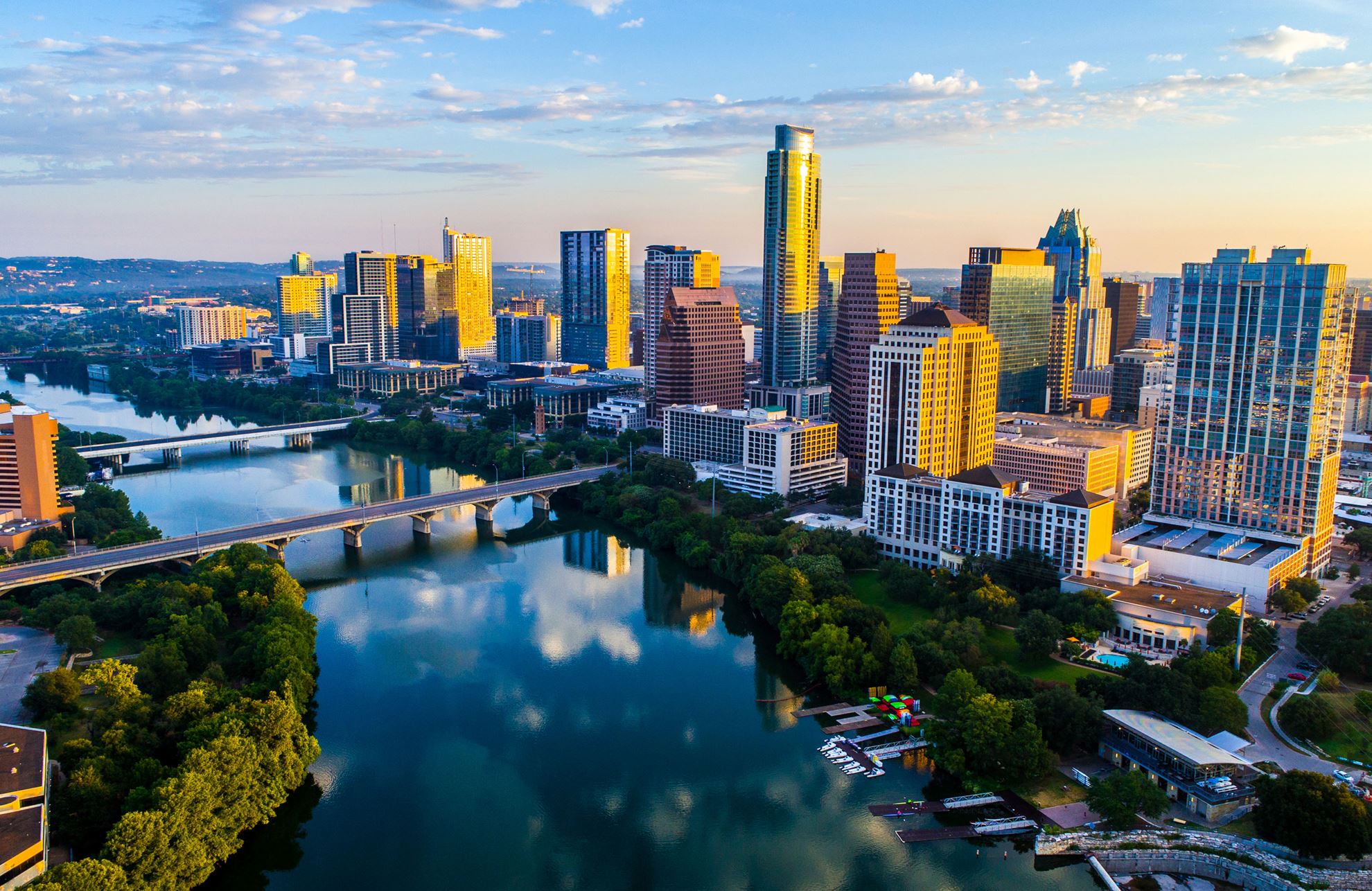
The Congress Avenue corridor and the CBD contain Austin's highest-value commercial properties, the 360 office towers, the Frost Bank Tower, the new Waterline development on the lake, and the hospitality and mixed-use blocks surrounding the Austin Convention Center. These buildings have complex rooftop environments: dense HVAC equipment, communication arrays, green roof elements, and in some cases pedestrian roof decks. Replacement and major repair on these buildings requires crane coordination with the City's Downtown Design Standards, after-hours work windows in some cases, and coordination with neighboring property management.
We have scoped and delivered work on mid-rise Class A office buildings in the downtown core. The work is logistically different from suburban warehouse replacement, crane reach, lane closure permits, material staging on a city block, but the roof system physics are the same. TPO and EPDM are the dominant membranes; we install to the same manufacturer specification and warranty requirements regardless of building height.
East Austin has shifted from light industrial to mixed-use retail, office, and residential since the city's 2004 Mueller Redevelopment Master Plan triggered the broader East Austin land use transition. The Mueller development itself, 700 acres on the former Robert Mueller Municipal Airport site, includes commercial and office buildings with relatively young roof systems (most installed between 2010 and 2020) that are approaching their first major maintenance window.
The broader East Austin corridor, East 6th Street, Airport Boulevard, and the industrial pockets east of Cesar Chavez, still has a significant legacy commercial inventory, including pre-1990 flat roofs on warehouse and light-manufacturing buildings. These older systems often require full replacement rather than recover; moisture saturation in 30-year-old insulation is common. We assess each building independently rather than applying a blanket recommendation.
South Congress and South Lamar
South Congress Avenue and South Lamar Boulevard have the highest concentration of ground-floor retail with flat-roof construction in Austin, the one- and two-story retail strips and mixed-use buildings between Oltorf Street and Ben White Boulevard that anchor this submarket. These buildings have moderate roof sizes (typically 5,000 to 30,000 sq ft) and high tenant turnover sensitivity: a leak above an active restaurant or retail space during a weekend generates immediate revenue impact for the tenant.
Our approach in this submarket emphasizes rapid assessment turnaround and same-day dry-in capability on any emergency work. If a storm event produces membrane damage on a South Congress retail building on a Friday, we can have crews on-site and a temporary dry-in in place before the weekend business period.
Domain and Northwest Austin Tech Corridor
The Domain in Northwest Austin, centered on Apple's Stonelake campus on the east side of MoPac, is Austin's second major office submarket. The Domain proper has over 9 million square feet of mixed-use and office development. Apple's campus on Stonelake is one of the largest single-tenant office complexes in Travis County. The buildings in this corridor are predominantly mid-2000s to 2010s construction: 10 to 20 year old TPO or EPDM systems that are at or approaching the NDL warranty's first renewal threshold.
Tech tenant requirements in this corridor are specific: server room and data center areas need zero-leak tolerance and require extra documentation at penetration flashings, HVAC curbs, and drain sumps. We approach Domain-area inspections with that tolerance as the baseline, not as an upgrade.
How quickly can you mobilize to an Austin commercial property for an emergency dry-in?
Inner-city properties, downtown, East Austin, South Congress, Mueller, Domain, get crews on-site within four business hours of confirmed authorization. Travis County suburban properties (Wells Branch, Pflugerville, Del Valle) are within same-day reach during business hours. We keep emergency dry-in materials staged at our supply point to avoid delays.
Does working near the Texas State Capitol or Downtown Austin require special permits?
Yes. Crane operations in the downtown core require City of Austin right-of-way permits and may require off-hours scheduling during peak traffic windows. Some blocks near the Capitol grounds have sight-line restrictions that affect equipment height. We handle permitting as part of pre-construction setup, we do not leave permit acquisition to the building owner.
Do you work on green roofs or vegetative roofing systems in Austin?
We inspect and assess green roof assemblies and can work on the waterproofing membrane under the growing medium. We do not maintain the horticultural elements. For buildings with extensive green roof systems, there are several in the Mueller development and a few downtown, we coordinate with the landscape contractor on the vegetative components while handling the membrane and drainage layer directly.
Schedule a roof assessment for your Austin building.
We cover every commercial submarket in the city. Our project managers will walk the roof and deliver a written condition report within five business days of the site visit.
Leak points, drainage, seams, penetrations, edge metal, roof access, and interior risk should be clear before the next roof decision is priced.
Immediate repair, maintenance, coating, recover, and replacement choices should be measured against roof age, moisture risk, tenant disruption, and budget timing.
A site visit is useful when the owner needs a documented roof condition, active leak response, storm review, or a clearer capital plan.