Commercial Roof Moisture Surveys in Austin, TX
Moisture in commercial flat roof insulation is invisible from the surface and fatal to a recover project if undetected. We survey Austin commercial roofs for insulation saturation using core sampling, nuclear gauge, and infrared methods before any recover or replacement scope is finalized.
The recover-versus-replace decision on any Austin commercial flat roof depends on whether the insulation is wet. Recovering over saturated insulation traps moisture against the deck, voids the new membrane warranty within the first year, and produces premature failure, the building owner pays for a new roof that fails on the same schedule as the one they covered. We do not finalize a recover scope without moisture survey data.
Moisture intrusion in commercial flat roof insulation in Austin typically originates at penetrations, at flashing failures around HVAC curbs and drains, and at seam failures that go undetected because the surface membrane appears intact while water is migrating laterally through the insulation. Austin's convective storm season, the documented intensity of events like the Halloween 2013 and Memorial Day 2015 floods, means a single intrusion event can saturate a significant insulation area before the leak manifests as interior damage.
We perform moisture surveys as a standalone service for Austin building owners assessing their roof's condition, as part of a pre-acquisition due diligence inspection, and as the precondition step before we finalize any recover scope we are hired to execute. The survey method depends on building size, roof system type, and budget: nuclear gauge scanning, physical core sampling, or infrared thermal imaging, each with distinct capabilities and constraints in Austin's climate.
Physical core sampling: We pull physical cores, typically one to two inches in diameter, at representative locations across the roof and at any area where surface condition or visual evidence suggests saturation. Core samples are evaluated visually and by feel for moisture content; saturated polyiso and mineral wool insulation are unmistakable at pull. Cores are pull-tested at five to ten locations for a standard Austin commercial building, more on large-format buildings with suspected widespread saturation. Core pulls are patched same-day to prevent additional intrusion.
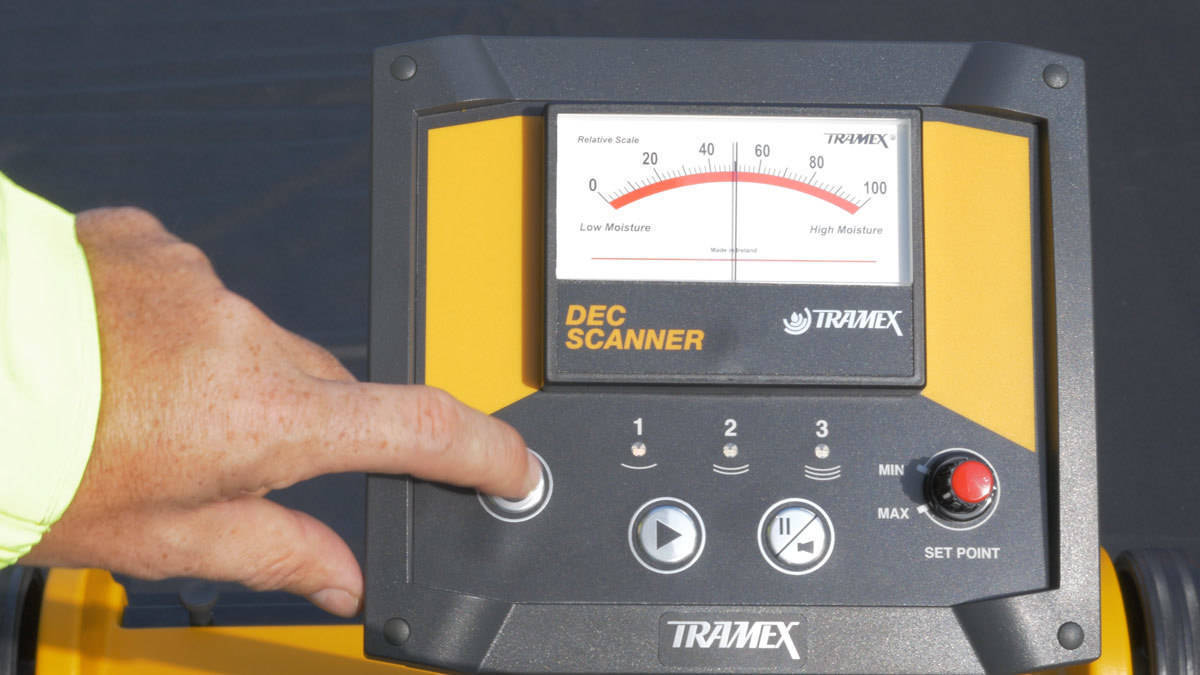
Nuclear gauge scanning: A nuclear moisture meter reads hydrogen density through the roof assembly at each test point, which correlates to moisture content in the insulation. Nuclear gauge scanning covers more area per hour than core sampling and is non-destructive, making it appropriate for large Austin commercial buildings where coring at full statistical density would be impractical. Nuclear gauge results are plotted on the roof diagram to produce a saturation map. Where gauge readings suggest saturation, we pull a core to confirm before drawing conclusions.
Infrared thermal imaging: Infrared scanning detects moisture by temperature differential, wet insulation retains heat longer than dry insulation after solar loading, and the thermal mass difference is detectable from above using a calibrated infrared camera after sunset. Austin's summer heat creates extended survey windows; the surface temperature differential persists past 10 PM on peak summer days, which is operationally useful for large-format surveys. Infrared results are photo-documented and mapped to the roof diagram.
Survey Report and Decision Support
The moisture survey report delivers a saturation map of the roof, a zone diagram with wet areas shaded by severity (suspected saturation, confirmed saturation by core, damp but not fully saturated) overlaid on the full roof footprint. The map also shows the location and result of each core pull and each nuclear gauge or infrared test point.
The report includes our assessment of the recover-versus-replace decision based on saturation extent. Our general threshold: if confirmed saturation covers less than 25% of the total insulation area, a recover with targeted insulation replacement in wet zones is a reasonable scope that avoids full replacement cost. If saturation exceeds 25%, full replacement is the appropriate scope, covering wet insulation is not an acceptable outcome. Between 10% and 25%, the economics and the owner's capital horizon drive the decision, and we present both options with cost implications.
For Austin buildings on the Edwards Plateau, we note any drainage-related moisture patterns, low points that do not drain, drain covers that are blocked or submerged during rainfall, and ponding areas that suggest tapered insulation deficiency. These patterns indicate ongoing moisture intrusion risk even after a recover, and they need to be addressed in the scope.
Pre-Acquisition Moisture Surveys
Austin's active commercial real estate transaction market, particularly in East Austin, South Congress, and the Mueller area, creates regular demand for pre-acquisition moisture surveys. A buyer acquiring a building with a 12-year-old roof wants to know not just whether the roof has failed but whether the insulation is wet, because wet insulation means a full replacement, not a recover, is in the capital plan.
We perform pre-acquisition moisture surveys on a compressed timeline when the due diligence window requires it. A standard Austin commercial building in the 20,000 to 60,000 sq ft range can be surveyed with physical cores and visual inspection in one site visit, with the written report delivered within three to five business days. Infrared surveys require a second visit after sunset but can be scheduled same-week in most cases.
For buyers who discover significant moisture saturation during due diligence, the survey report provides the documentation for a purchase price renegotiation. We have produced reports used in exactly this context on Austin commercial properties. We do not advocate for any negotiating position, we document what we found.
How many core samples are pulled in a typical Austin commercial roof moisture survey?
For a 30,000 to 60,000 sq ft building with no specific suspected moisture areas, we typically pull five to eight cores at representative locations, one per major zone plus additional cores at areas with surface evidence of prior repair or flashing failure. If nuclear gauge or infrared scanning identifies specific suspect areas, we add targeted cores in those zones. The core count is not fixed; it reflects the building's size and what the non-destructive methods show.
Does Austin's summer heat affect infrared moisture survey accuracy?
Austin's heat actually extends the useful survey window. The solar loading on a summer day creates a strong thermal mass differential between wet and dry insulation that persists well past sunset, often until 10 or 11 PM. This makes summer the preferred season for infrared surveys in Austin, not a constraint. Winter surveys are more challenging because the thermal differential is smaller and the window after sunset is shorter.
Can moisture surveys be conducted on occupied buildings?
Yes. Core pulls require roof access but do not affect building operations below, the core is pulled from above, patched same-day, and the building below is not disturbed. Nuclear gauge and infrared surveys are entirely above-deck. We coordinate with building management for roof access and work around any rooftop mechanical servicing scheduled for the same day.
Schedule a moisture survey for your Austin commercial roof.
We perform core sampling, nuclear gauge, and infrared surveys for Austin commercial buildings. Results are delivered in a written saturation map report within five business days of the site visit.
Leak points, drainage, seams, penetrations, edge metal, roof access, and interior risk should be clear before the next roof decision is priced.
Immediate repair, maintenance, coating, recover, and replacement choices should be measured against roof age, moisture risk, tenant disruption, and budget timing.
A site visit is useful when the owner needs a documented roof condition, active leak response, storm review, or a clearer capital plan.