
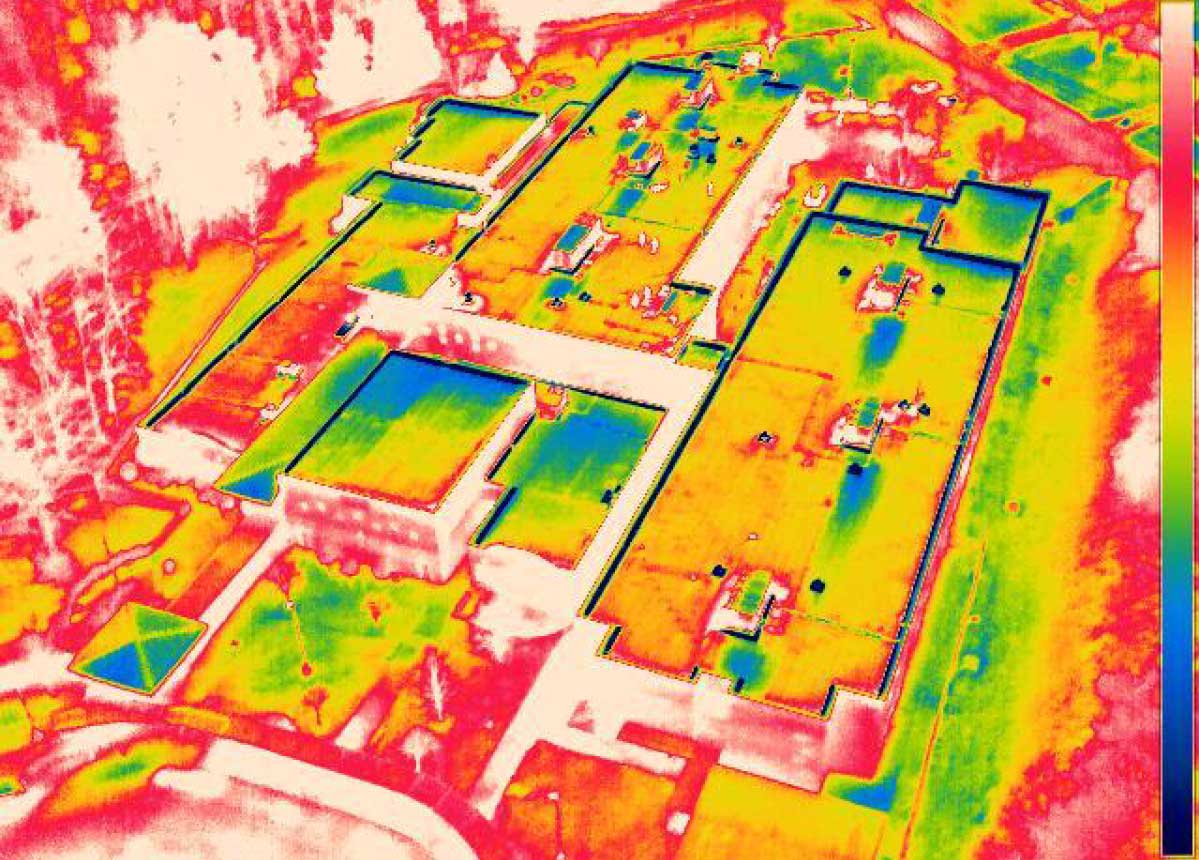
Infrared Roof Scanning in Austin, TX
Infrared thermal imaging detects moisture in commercial flat roof insulation non-destructively, no core pulls, no disruption, coverage of the full roof area in a single after-sunset scan. We perform infrared surveys on Austin commercial buildings and deliver a mapped saturation report.
Infrared roof scanning works because wet insulation retains heat differently than dry insulation. After a day of solar loading, which Austin provides in abundance across its 300-plus days of measurable sunshine per year, dry insulation releases heat relatively quickly after sunset, while wet insulation holds thermal mass longer. That temperature differential is detectable with a calibrated infrared camera from above the roof surface, producing a thermal map that identifies moisture-compromised zones without touching the membrane.
Austin's climate creates ideal conditions for infrared roof surveys. Summer surface temperatures on commercial flat roofs in the 78701 to 78741 zip codes routinely exceed 150°F at peak afternoon. The thermal mass loaded into wet insulation during a Central Texas summer day is substantial, the post-sunset differential between wet and dry zones is typically five to fifteen degrees Fahrenheit, well above the detection threshold of a properly calibrated camera. Survey windows in Austin extend until 10 or 11 PM on summer evenings, compared to an hour or two post-sunset in cooler markets.
We perform infrared roof scans for Austin commercial building owners assessing moisture intrusion, for buyers conducting pre-acquisition due diligence, and as the large-area screening method before we select core pull locations on large-format buildings. Infrared scanning is most effective on buildings with polyiso or EPS insulation under a single-ply or modified bitumen membrane, the thermal conductivity difference between wet and dry is most detectable on these assemblies.
How We Conduct Infrared Surveys in Austin
Survey scheduling: We schedule infrared surveys for late evening after a clear-sky day with full solar loading. Austin's weather is cooperative for this most of the year; the challenge is scheduling around the spring convective storm season, when afternoon cloud cover can reduce solar loading enough to compromise the thermal differential. We monitor weather forecasts for the survey window and reschedule if loading conditions are inadequate.
Equipment and calibration: We use a calibrated forward-looking infrared (FLIR) camera with a thermal resolution appropriate for commercial roof work. Camera calibration is verified before each survey session. Emissivity settings are adjusted for the membrane type, TPO, EPDM, modified bitumen, and BUR have different emissivity profiles that affect temperature reading accuracy.
Survey walk pattern: We walk the full roof in a systematic pattern, recording continuous video rather than spot images. Every square foot of the roof surface is captured in the survey record. After the walk, we review the thermal footage frame by frame to identify anomalous temperature areas and map their locations on the roof diagram. We do not make determinations from spot photographs; we review the full scan.
Interpreting Austin Infrared Survey Results
Infrared results require interpretation against Austin's specific context. Thermal anomalies on a commercial roof can indicate moisture, but they can also indicate variations in insulation thickness, fastener patterns at high density, conduit runs under the membrane, or residual heat from rooftop equipment. A raw thermal image without interpretation context is not a moisture survey, it is a photograph that requires analysis.
We map thermal anomalies on the roof diagram, annotate each anomaly by type and confidence level (high-confidence moisture indication versus anomaly requiring core confirmation), and recommend core pull locations where the thermal evidence suggests saturation but is not conclusive. The final saturation map in the report distinguishes confirmed saturation (supported by core data) from suspected saturation (thermal evidence only) from non-moisture anomalies.
Austin buildings with complex rooftop environments, dense HVAC equipment, communication arrays, multiple rooftop levels, present more interference sources that require careful interpretation. The Domain office corridor and downtown Austin mid-rise buildings have the most complex rooftop environments in the market. We note interference sources explicitly in the report so the owner can evaluate the confidence level of each anomaly.
Infrared Scanning for Large-Format Austin Buildings
Large-format commercial buildings, 100,000 sq ft and above, are where infrared scanning's non-destructive full-coverage capability has the clearest advantage over core-only surveys. Core sampling a 200,000 sq ft warehouse east of I-35 at the statistical density needed for full confidence would require 20 to 40 pulls, each of which needs to be patched. A single infrared scan covers the full area in two to three hours and identifies the specific zones where cores should be pulled to confirm thermal evidence.
The combined infrared-plus-targeted-core approach is our standard methodology for large Austin commercial roofs where moisture survey is indicated. Infrared covers the full area and identifies anomalies; targeted cores confirm the highest-confidence anomaly locations; the saturation map combines both data types. This is more efficient than grid-pattern coring and produces higher spatial resolution on the moisture map than coring alone.
Austin's east-of-I-35 industrial corridor, the warehouse and distribution clusters near Austin-Bergstrom International Airport and the US 183 corridor, has a concentration of large-format buildings with aging roof systems where this combined methodology is regularly appropriate. Several buildings in this submarket have roof systems installed in the 2005 to 2015 window that are now at or past the first major maintenance decision point.
What is the best time of year to perform infrared roof scanning in Austin?
Late spring through early fall, May through September, produces the best conditions for infrared surveys in Austin because the solar loading intensity and duration create the strongest thermal differential between wet and dry insulation. Winter surveys are less reliable because the differential is smaller and the post-sunset survey window is shorter. Spring is operationally complicated by Austin's convective storm season, which can generate afternoon cloud cover that reduces solar loading.
Can infrared scanning detect moisture under all commercial roof membrane types?
Infrared works best on single-ply membranes over polyiso or EPS board insulation, the most common assembly on Austin commercial buildings. It is less effective on built-up roofing with gravel ballast, because the gravel layer absorbs and retains heat independently, creating false anomalies. For BUR systems in Austin, we rely more heavily on core sampling. EPDM over polyiso, and TPO over polyiso, are ideal subjects for infrared.
How is an infrared scan report different from a standard condition report?
A standard condition report documents visible surface defects, what we can see by walking the roof in daylight. An infrared scan report maps subsurface moisture in the insulation layer, what we can detect thermally that is invisible to a daylight walk. The two are complementary; a complete assessment for a building where moisture intrusion is suspected should include both.
Schedule an infrared roof scan for your Austin building.
We perform after-sunset infrared surveys on Austin commercial roofs and deliver a mapped saturation report within five business days of the scan.
Leak points, drainage, seams, penetrations, edge metal, roof access, and interior risk should be clear before the next roof decision is priced.
Immediate repair, maintenance, coating, recover, and replacement choices should be measured against roof age, moisture risk, tenant disruption, and budget timing.
A site visit is useful when the owner needs a documented roof condition, active leak response, storm review, or a clearer capital plan.