
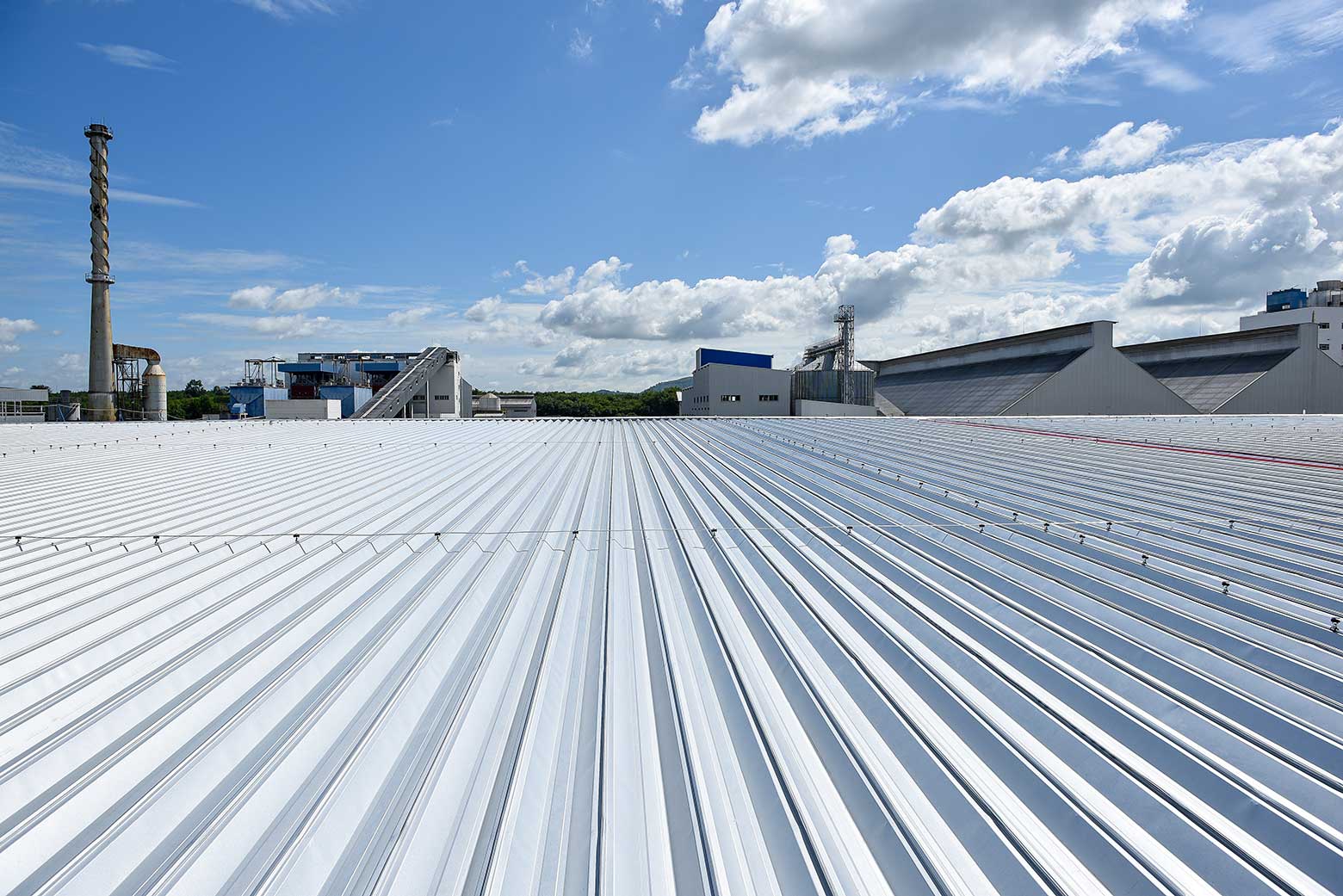
Standing Seam Metal Roofing in Austin, TX
Concealed-fastener steel and aluminum standing seam panels for Austin commercial buildings, designed for Central Texas wind loads, hail exposure, and thermal expansion on large-format roofs.
Standing seam metal roofing is the dominant choice for Austin commercial projects where long service life and low ongoing maintenance cost matter more than first-cost minimization. The system's defining feature, a raised, concealed-fastener seam that clips to the structure without piercing the panel, eliminates the exposed-fastener leak points that account for most failures on older metal panel roofs across the Austin metro.
Central Texas puts specific demands on metal roofing that drive panel and clip selection. The temperature differential between an Austin January night (28°F is not unusual, as the February 2021 freeze documented) and a July afternoon surface (panels can exceed 160°F in direct sun) requires expansion clips designed for panels spanning 30 to 50 feet without buckling or fastener walking. The Edwards Plateau's karst substrate under much of the metro creates drainage constraints that affect valley and gutter design on sloped metal roofs, water cannot simply percolate through the ground as it might elsewhere.
Austin's hail exposure is a real design consideration. The June 2024 event deposited quarter-size stones across Round Rock and Pflugerville. Standing seam steel panels, typically 24-gauge Galvalume or painted steel, hold up significantly better to that impact profile than 26-gauge panels or lightweight aluminum on buildings in the hail belt north of US 183. We specify gauge based on the building's location, roof pitch, and exposure category, not on a blanket standard.
Panel Systems and Material Selection
Steel standing seam panels on Austin commercial projects typically run 24-gauge Galvalume or PVDF-coated painted steel. Galvalume's aluminum-zinc alloy coating provides superior corrosion resistance compared to galvanized in Central Texas humidity conditions, particularly on roofs near the Colorado River corridor where morning condensation cycles are frequent. PVDF (Kynar 500) paint systems carry 30- to 40-year finish warranties for chalking and fading, relevant in a market where UV index runs high year-round.
Aluminum standing seam is specified for buildings requiring lighter dead load or where coastal corrosion is a concern, less common in Austin proper but relevant for the Hill Country edge cities like Marble Falls and Fredericksburg where some commercial clients operate. Aluminum expands and contracts at roughly twice the rate of steel per linear foot of temperature differential, which makes clip design more critical and requires wider seam profiles than equivalent steel systems.
Snap-lock versus mechanical-seam systems: snap-lock panels clip together without a seaming machine and are appropriate for roof pitches above 3:12. Mechanical-seam systems, where a field seaming machine folds the raised edge double, are required for low-pitch applications and are the appropriate choice for Austin commercial buildings with minimal visible slope. We do not apply snap-lock panels on pitches below manufacturer minimum, a failure mode common in buildings installed during Austin's rapid construction period between 2016 and 2022.
Structural and Wind-Uplift Design
Austin commercial buildings in the IBC 2021 wind zone require engineering-documented clip spacing and panel width calculations. The calculation depends on the building's Exposure Category (B or C depending on adjacent terrain and building height), roof zone (field, perimeter, corner), and panel width. Buildings along the SH 130 toll corridor in southeast Travis County and on open-terrain lots near the Austin-Bergstrom International Airport sit in higher wind-exposure conditions than sheltered urban sites.
Clip spacing and type govern the system's FM Global or UL uplift rating, which many Austin commercial property insurers require. We design clip patterns to the building's required rating rather than to cost minimization, an under-fastened metal roof that lifts during a March thunderstorm costs more to remediate than the savings from a reduced clip count.
Structural deck compatibility matters on standing seam over commercial substrates. Steel standing seam clips attach to structural purlins or to a sub-framing system over an existing roof assembly. On reroofing applications over existing low-slope membranes, we evaluate whether the existing deck can support the added load and whether penetrations through the existing membrane can be waterproofed at each clip anchor point without voiding the underlying system's warranty.
Installation and Closeout on Austin Projects
Panel installation sequencing on Austin commercial projects accounts for the city's convective weather pattern. Panels are installed with same-day ridge and gutter completion on each day's section, we do not leave open ridges overnight during spring storm season. The Memorial Day 2015 and Halloween 2013 flood events documented Central Texas's capacity for fast, heavy convective rainfall even on marginally cloudy days.
Penetrations through standing seam panels, HVAC duct, plumbing vents, conduit, are flashed with pitch pans or factory-formed collars that maintain the concealed-fastener integrity of the system. Field-cut holes with sealant-only flashing are a documented failure mode on Austin commercial metal roofs; we do not use that approach.
Closeout documentation includes panel manufacturer finish warranty registration, structural engineering sign-off on clip pattern, and a photo-keyed condition record of all penetrations, ridge caps, gutter terminations, and valley details. Buildings in the Domain area and the East 6th tech corridor that require LEED documentation receive the panel data sheets needed for Materials and Resources credit submissions.
How does Austin's heat affect standing seam metal panel expansion?
A 50-foot steel panel going from a January low of 28°F to a July surface peak of 160°F expands roughly 0.7 inches across its length. Floating clips that allow the panel to slide independent of the structure accommodate this movement without buckling or fastener walking. Fixed-clip or through-fastened systems on that same panel will eventually walk fasteners or corrugate the panel face, we do not install fixed-clip systems on panel runs above manufacturer's length limit for Austin's temperature range.
Is standing seam metal roofing appropriate for Austin's flat commercial buildings?
Mechanical-seam standing seam can be installed on pitches as low as 1/2:12, making it viable for low-slope Austin commercial buildings where the building's structure allows enough rise for drainage. Below that pitch, single-ply membrane systems are the better-documented choice. The cost premium for standing seam relative to TPO is worth evaluating against the expected maintenance cost difference over a 30 to 40-year horizon, metal roofing typically requires less reactive maintenance but more attention to sealant renewal at penetrations.
What permit is required in Austin for a commercial metal roofing project?
The City of Austin Development Services Department requires a commercial roofing permit for replacement projects. Projects involving structural attachment to new purlins or sub-framing may require a structural review addendum. We pull permits as part of project setup and include permit cost in the project scope, the owner does not manage their own permitting on any project we deliver.
Get a written standing seam scope for your Austin building.
Our project managers will assess your building's structure, pitch, and hail exposure, then produce a panel specification and clip-pattern design you can use for competitive bid or direct award.
Leak points, drainage, seams, penetrations, edge metal, roof access, and interior risk should be clear before the next roof decision is priced.
Immediate repair, maintenance, coating, recover, and replacement choices should be measured against roof age, moisture risk, tenant disruption, and budget timing.
A site visit is useful when the owner needs a documented roof condition, active leak response, storm review, or a clearer capital plan.