
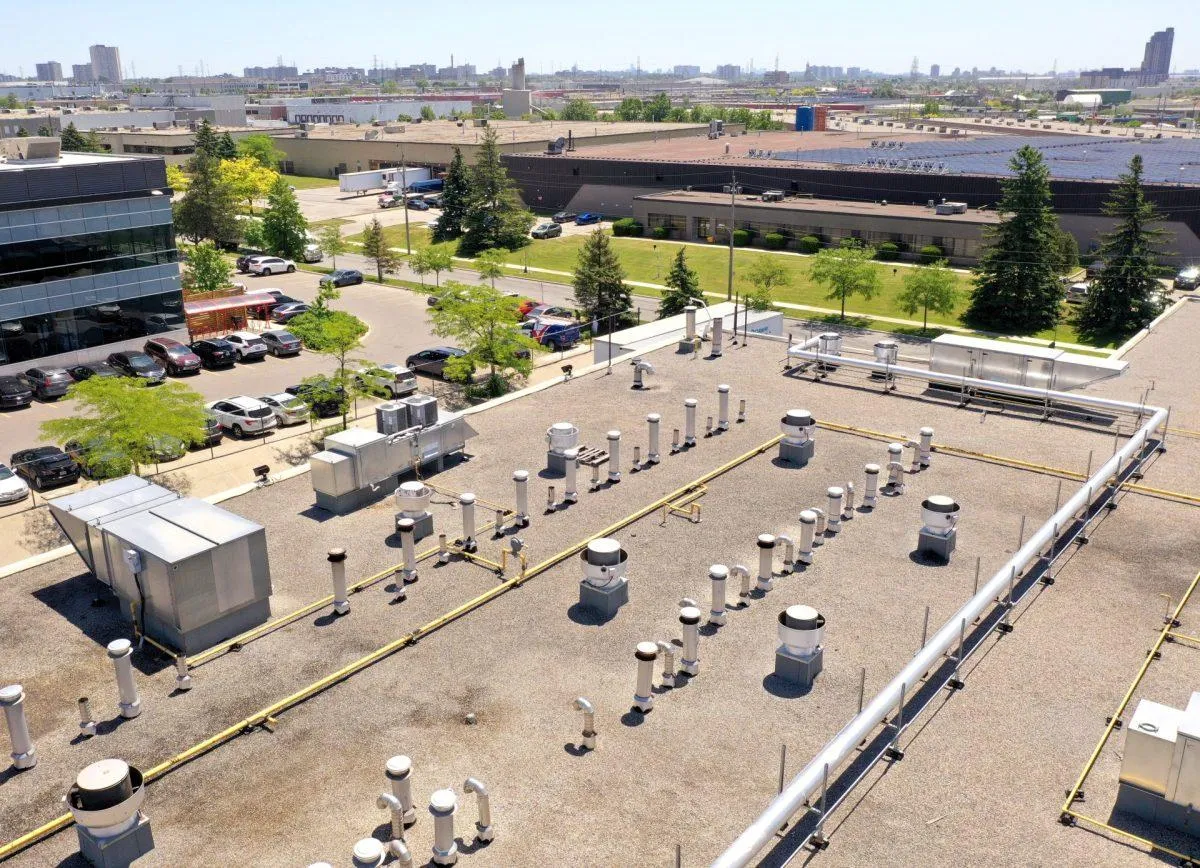
Food Processing Facility Roofing in Austin, TX
Roofing for Austin Food Processing Plants
A food processing roof has to survive two things at once that most commercial roofs never face: a constant flood of warm, humid air rising from washdown and cook areas below, and the weight and vibration of heavy refrigeration equipment sitting on top. Get either one wrong and you end up with a wet roof assembly, corroded deck, and the last thing a food plant can afford, which is water dripping toward a production line during an inspection.
We build and maintain low-slope roofs for bakeries, commissaries, meat and protein processors, beverage and packaging plants, and cold-storage operations across the Austin area. Food production has expanded with the region, and we see this work clustered through the East Austin and St. Elmo industrial districts, along the US-183 manufacturing belt, out in the Southeast Austin warehouses near SH-130, and up the I-35 corridor through Round Rock and Pflugerville where distribution and food businesses keep landing.
Washdown Humidity Attacks the Roof From Inside
Sanitation washdowns and steam from cooking, pasteurizing, and cleaning push enormous amounts of moisture into the air inside a food plant. That warm, wet air rises, finds the cold underside of the roof deck, and condenses there. Over time it corrodes a steel deck, soaks insulation that was never meant to get wet, and grows the kind of moisture and mold problems that no food operation wants anywhere near its product. Like a car wash but at a larger scale, a food plant roof is often attacked from below before anything is visible on top.
Every food processing roof we design starts with a vapor retarder strategy. We install a continuous, sealed vapor barrier over the deck so interior humidity cannot reach the insulation, specify insulation that will not hold water, and use corrosion-resistant fasteners suited to a high-humidity interior. We also coordinate with your sanitation and HVAC setup, because a plant that does not exhaust enough moisture is just driving it into the roof.
- A continuous sealed vapor retarder to keep washdown and process humidity out of the assembly
- Non-wicking polyiso insulation that protects R-value even in a wet interior environment
- Corrosion-resistant fasteners and plates rated for a humid, washdown-driven building
- Coordination with exhaust and make-up air so the building is not pushing moisture into the deck
Engineering the Roof for Heavy Refrigeration Loads
Cold storage and refrigerated processing put serious weight on a roof: large condenser and compressor racks, evaporative units, refrigerant lines, and the vibration that comes with running them around the clock. We verify that the deck and structure can carry the equipment, build engineered curbs that spread the load and isolate vibration, and detail every refrigerant penetration so the constant temperature swings around those lines do not crack the flashing. Cold-storage roofs also fight condensation hard, so the vapor strategy on those buildings is even more aggressive.
Membrane choice matters here. For most food plants we specify a reinforced PVC membrane, hot-air welded into one continuous sheet, because PVC resists the animal fats, oils, and cleaning chemicals that land on a food-processing roof and stands up to grease far better than EPDM. Where there is heavy traffic for equipment service, we add walkway pads so your maintenance crews never cut into the field.
Sanitation, Drainage, and Central Texas Weather
A food plant cannot have standing water on the roof. Ponding over a humid building accelerates corrosion and condensation, and a leak over a production area is a sanitation and compliance failure, not just a maintenance item. We build positive drainage into every food-plant roof, correct flat and ponding decks with tapered insulation, and keep drains, scuppers, and overflows clear and tested. Austin sits in Central Texas hail alley and takes hard spring thunderstorms, so on exposed sites we specify impact-resistant membranes and reinforced detailing. After the 2021 winter freeze, we also pressure-check internal drains and condensate lines so a hard freeze does not back water up over your line.
Keeping the Plant Running During the Work
Food production runs on tight schedules and strict sanitation, so we treat occupied-plant roofing as a controlled job. We seal openings at the end of every shift, protect production and storage areas from any debris, schedule cutting and hot work around your sanitation and production windows, and coordinate around live exhaust and refrigeration so nothing critical goes down during a run. When we tie into equipment curbs, we plan those cut-overs for your downtime, not ours.
Foreign-Material Control Belongs in the Roofing Plan
In a food plant, anything that can fall from the roof into the process is a hazard, and auditors treat it that way. We plan our work to keep fasteners, membrane scraps, insulation crumbs, and tools controlled and counted, with tarping and containment over any open production area and a sweep of the work zone before each shift hands back. Cutting and grinding are staged away from intakes and open product, and we coordinate with your QA team so the roofing crew is working to the same foreign-material standard the rest of your plant follows. That discipline is the difference between a reroof that passes a surprise inspection and one that triggers a finding.
We extend the same thinking to rooftop equipment. Condensate from refrigeration units and HVAC has to be routed deliberately to drains, never allowed to weep across the membrane and pool, because standing condensate over a food building is both a roof problem and a sanitation problem.
Planning Replacement Before It Becomes an Emergency
The worst time to replace a food-plant roof is the week it starts leaking over a line during peak season. We help operators get ahead of that with condition assessments that tell you how much service life is left in the existing assembly, where the moisture has already gotten into the insulation, and what a phased replacement would look like done section by section during scheduled downtime. For a plant that runs year-round, a planned, staged reroof that never interrupts production is worth far more than the cheapest emergency patch.
- A roof assessment that checks the deck underside, insulation moisture, and refrigeration loads
- A vapor and drainage strategy built for a washdown, high-humidity building
- Engineered curbs and detailing for heavy refrigeration equipment and refrigerant lines
- A grease- and chemical-resistant welded membrane with protected service routes
- Occupied-plant scheduling that respects your sanitation and production requirements
If you run a food processing or cold-storage operation anywhere in the Austin metro and you are seeing ceiling stains, rusting deck, or sweating insulation, the humidity cycle is working against your roof from the inside. Call us, and we will open it up, check the loads and the moisture, and give you a roof that holds up to the way a food plant actually runs.
Leak points, drainage, seams, penetrations, edge metal, roof access, and interior risk should be clear before the next roof decision is priced.
Immediate repair, maintenance, coating, recover, and replacement choices should be measured against roof age, moisture risk, tenant disruption, and budget timing.
A site visit is useful when the owner needs a documented roof condition, active leak response, storm review, or a clearer capital plan.