
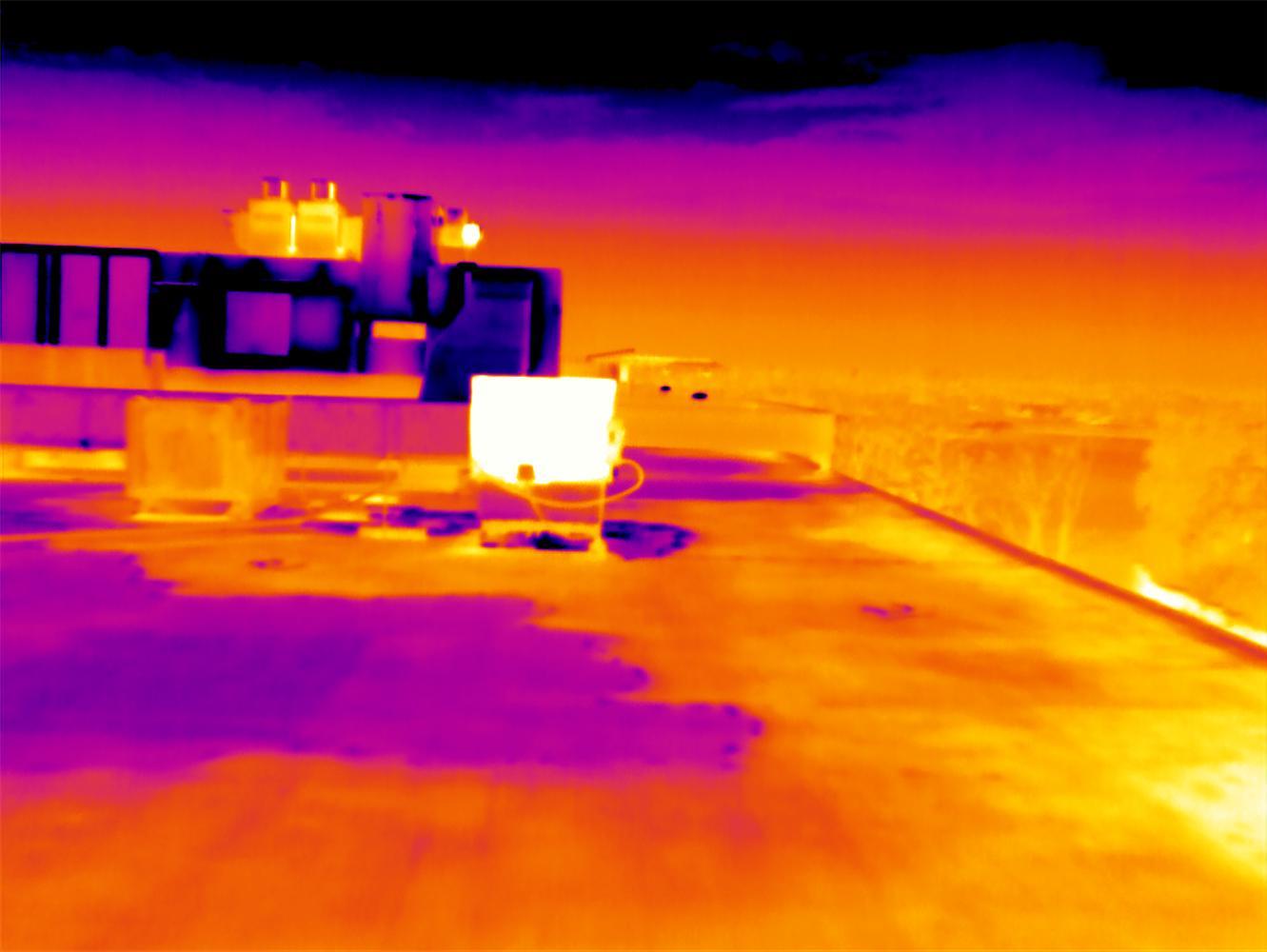
Infrared Moisture Scanning in Austin, TX
Infrared thermography maps wet insulation under the membrane without cutting the roof open. For Austin commercial buildings weighing recover versus replacement, or disputing an insurance claim, accurate moisture data changes the math.
The recover-versus-replace decision on a commercial flat roof comes down to one variable more than any other: how much of the insulation is wet. A roof with less than 25% moisture saturation across the field is typically a recover candidate, new membrane over dry insulation, targeted replacement of wet zones, 15 to 20 years of additional service life at roughly half the cost of full replacement. A roof with more than 25% wet insulation needs full replacement. The difference in capital requirement between those two decisions on a 100,000 sq ft Austin warehouse can be $400,000 or more.
Infrared moisture scanning gives you a map of wet insulation before you commit to either scope. The physics: wet insulation retains daytime solar heat longer than dry insulation. After sunset, when the roof surface cools, the wet zones radiate heat back to an infrared camera as warmer areas, they show up as bright signatures against the cooler dry field. A properly conducted nighttime infrared scan on an Austin flat roof, flown or walked with a calibrated thermal camera after at least four hours of direct sun with no cloud cover and no precipitation in the prior 48 hours, maps moisture to within approximately 5% of the area identified by invasive core sampling.
We use infrared scanning as a standard tool in pre-construction due diligence on any commercial roof where the recover-versus-replace question is unresolved. We also use it for post-repair verification, confirming that a targeted repair dried out the underlying insulation rather than trapping residual moisture. For insurance claims after the documented Austin-area flooding events, infrared scanning provides a spatial moisture map that an adjuster can use to evaluate the claim boundary.
How an Austin Infrared Scan Is Conducted
Scan conditions: Infrared moisture detection requires a minimum four-hour differential between daytime surface heating and post-sunset surface cooling. Austin's summer and early fall days, consistent 100°F+ ambient temperatures with 10 to 12 hours of direct sun, create ideal contrast conditions. Spring and late fall scanning requires more careful timing and sometimes a second scan night if cloud cover disrupted the solar loading.
Equipment: We use a calibrated FLIR thermal camera with a resolution appropriate to the roof area being scanned. Large roofs, 50,000 sq ft or more, common on the warehouse and light-industrial buildings east of I-35 near Austin Bergstrom International Airport, are typically walked in a grid with overlapping frames. Smaller roofs on South Congress or East 6th retail buildings can be completed in a single systematic pass.
Ground-truth cores: Infrared scanning identifies suspect zones; core sampling confirms them. After a scan, we pull moisture cores in five to ten locations selected from the thermal map, both identified wet zones and presumed dry zones for comparison. Core results are correlated back to the thermal image to validate scan accuracy before the final moisture map is issued. A scan report without ground-truth cores is a hypothesis; a scan with correlated cores is a deliverable you can make a $500,000 capital decision with.
When Infrared Scanning Changes the Decision
Pre-bid scoping: When a building owner in the Domain area or along the I-35 North corridor gets competing bids that disagree sharply on replace versus recover, an infrared scan resolves the disagreement with data rather than contractor opinion. The scan report lets the owner evaluate both bids against the same moisture baseline.
Post-storm insurance claims: After the Memorial Day 2015 floods and the October 2015 flooding events in Travis County, roof claims on affected commercial buildings were complicated by the difficulty of establishing which moisture damage was storm-induced versus pre-existing. An infrared scan conducted within 30 days of a weather event, with documented scan date, weather data for the preceding 48 hours, and correlated core samples, gives an adjuster a defensible boundary between event damage and pre-existing saturation.
Warranty claim support: If a building owner suspects that a recently installed roof system has a moisture intrusion defect, insulation wet after a new installation that should be dry, infrared scanning maps the affected area without destructive tear-off. The scan report is the documentation the manufacturer's warranty representative needs to evaluate the claim.
What the Infrared Scan Report Includes
The report delivers: a calibrated thermal image of the full roof area with wet zones outlined and labeled, a corresponding zone diagram matching the thermal image to the physical roof layout, core sample results correlated to the thermal map, a moisture saturation estimate expressed as percentage of total roof area, a recover-versus-replace recommendation based on the saturation percentage, and cost-range estimates for both options at the identified saturation level.
For buildings in the 78702, 78741, and 78745 zip codes, which include a high concentration of flex industrial and light-manufacturing buildings in the Riverside Drive and Ben White Boulevard corridors, we have developed baseline familiarity with the roof system types common to the older building stock in those areas. That context helps us calibrate the scan results to the specific insulation types more accurately than a one-off scan without building history.
What time of year is best for infrared scanning in Austin?
June through October provides the most reliable scan conditions, Austin's sustained summer heat and low cloud cover frequency give long solar loading windows. Spring scanning is feasible but requires more careful scheduling around Central Texas's storm season. Winter scanning is possible but less reliable due to shorter daylight hours and reduced temperature differential.
Can infrared scanning find leaks rather than just moisture?
Infrared scanning maps wet insulation, not active leak points. The wet insulation zone is typically downslope or down-drainage from the actual membrane breach, the leak entry point is above the saturated area on the roof. We use the infrared map to identify wet zones and then perform targeted probe testing and visual inspection at the upslope perimeter of each wet zone to locate the source breach.
Is infrared scanning worth it on a small roof?
On roofs under 10,000 sq ft, the scan fee is often comparable to the cost of a five-point core sampling program. For very small roofs, we sometimes recommend core sampling alone. For roofs above 20,000 sq ft where the replace-versus-recover cost difference is material, infrared scanning almost always pays for itself in the accuracy of the scope it supports.
Schedule an infrared moisture scan for your Austin commercial roof.
We conduct the scan, pull ground-truth cores, and deliver a written report with moisture map and recover-versus-replace recommendation within five business days.
Leak points, drainage, seams, penetrations, edge metal, roof access, and interior risk should be clear before the next roof decision is priced.
Immediate repair, maintenance, coating, recover, and replacement choices should be measured against roof age, moisture risk, tenant disruption, and budget timing.
A site visit is useful when the owner needs a documented roof condition, active leak response, storm review, or a clearer capital plan.