
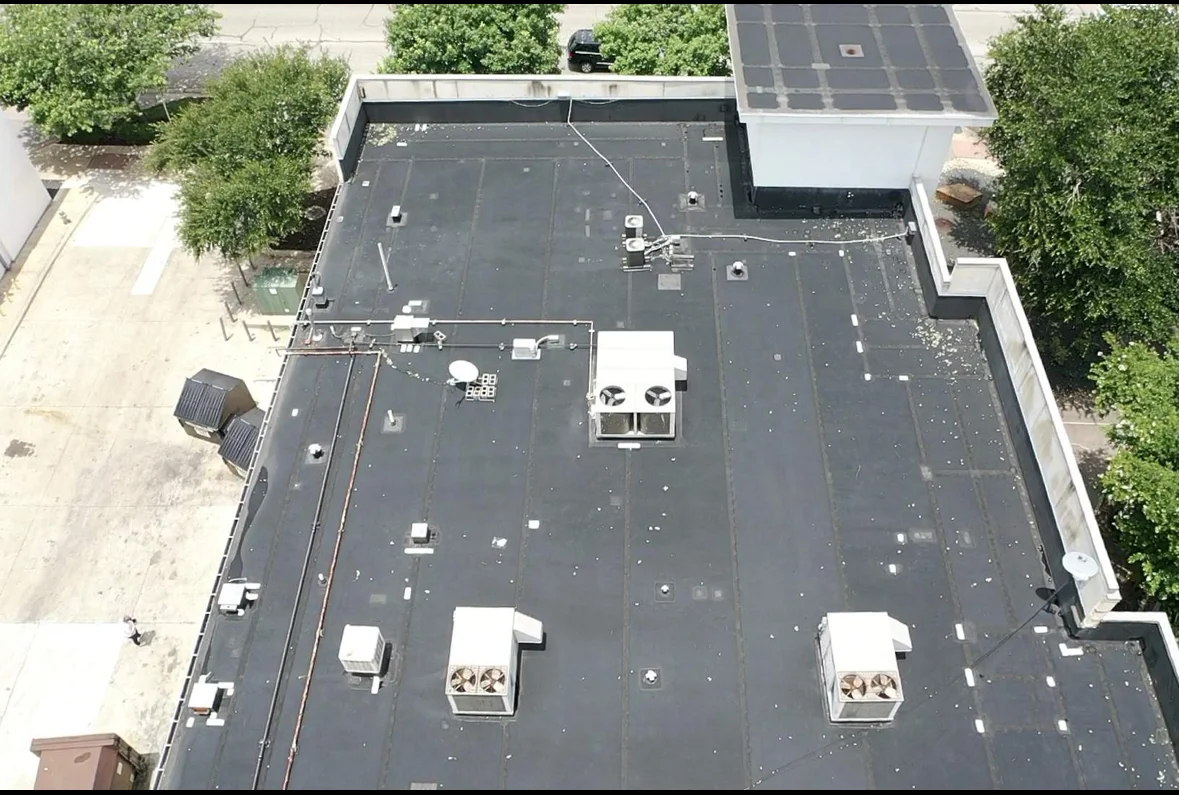
EPDM Roofing in Austin, TX
Ethylene propylene diene monomer roofing for Austin commercial and industrial buildings, 60-mil fully adhered and mechanically fastened systems, with seam methods and installation details suited to Central Texas thermal cycling.
EPDM has been installed on commercial buildings since the 1970s and remains the membrane of choice for industrial and manufacturing applications where black surface temperature is operationally acceptable, mechanical traffic is high, and chemical exposure or rooftop equipment density makes a heat-welded single-ply membrane less practical. In the Austin MSA, EPDM is concentrated in the older industrial inventory east of I-35, in light-manufacturing along the SH 130 toll corridor near the Tesla Gigafactory Texas site in Del Valle, and on buildings where the existing BUR or modified bitumen system is being replaced without converting to a white-membrane system.
The thermal performance trade-off relative to TPO is real and we are direct about it. A black 60-mil EPDM membrane on a flat Austin commercial roof will surface-heat to 155 to 165°F on a peak July afternoon. A white 60-mil TPO on the same building will surface at 100 to 115°F. For an office building in the Domain or a retail building on South Congress Avenue, that difference has direct HVAC cost consequences. For a tilt-wall warehouse with minimal HVAC load or a manufacturing facility where roof surface temperature is secondary to membrane durability and chemical resistance, EPDM's advantages, resistance to ozone and UV degradation, flexibility at low temperatures, and compatibility with a wider range of adhesive systems, may outweigh the reflectivity difference.
We install, repair, and recover EPDM on Austin commercial buildings. We do not default to TPO on every project, we assess the building's use, the existing system, and the owner's priorities and recommend accordingly.
EPDM Installation Methods for Austin Buildings
Fully adhered EPDM: The membrane is bonded to the insulation substrate with bonding adhesive applied to both surfaces and allowed to flash off before the membrane is rolled into contact. Fully adhered systems provide the highest wind-uplift resistance and eliminate billowing at seams in the high-wind gusts that accompany Austin's convective storm events. We use fully adhered systems on buildings in wind Exposure Category C, open terrain, elevated sites, or locations near the Balcones Escarpment where terrain-induced wind acceleration is documented.
Mechanically fastened EPDM: The membrane is fastened through the insulation to the structural deck with fasteners and plates at defined spacing, with seams lapped and adhered. Faster installation than fully adhered and lower adhesive cost, at some reduction in wind-uplift resistance. Appropriate for low-exposure industrial buildings where installation speed and cost are primary criteria.
Seam methods: EPDM seams are bonded with EPDM lap adhesive or completed with EPDM tape systems. Unlike TPO and PVC, EPDM cannot be heat-welded, the chemistry is incompatible with hot-air fusion. Seam quality depends entirely on surface preparation, adhesive application, and cure conditions. We pay particular attention to seam preparation on Austin EPDM projects because the wide temperature swings between winter nights and summer afternoons (a range that can exceed 130°F in a single year) create thermal cycling stress that exploits any adhesive-application deficiency.
EPDM Repair on Aging Austin Commercial Roofs
EPDM repairs fall into three categories: seam re-adhesion, membrane patch, and flashing replacement. Seam re-adhesion applies to open or lifting lap seams where the original adhesive has failed, the seam is cleaned, primed, and re-bonded with fresh EPDM adhesive or covered with EPDM tape. Membrane patches address punctures, tears, or small split areas using EPDM patch material bonded with compatible adhesive and sealed at the perimeter with EPDM primer and sealant.
Flashing replacement is the most common repair on Austin EPDM roofs over 15 years old. The flashing at HVAC curbs, pipe penetrations, and parapet terminations uses butyl-based or EPDM-specific sealants that have a shorter service life than the field membrane, we typically see flashing sealant failure on Austin EPDM roofs between years 12 and 20, depending on UV exposure and maintenance history. Full flashing strip and replacement is the correct scope; caulking over failed flashing is a short-term fix that creates a more complex repair later.
Buildings in the Mueller redevelopment district and the East Austin warehouse corridor have a significant inventory of pre-1995 EPDM roofs. On these older systems, repair viability depends on the membrane's current tensile strength and elongation, aged EPDM that has lost elasticity cannot be patched effectively because the patch boundary becomes the next failure point. We assess older EPDM by physical condition and core sampling before recommending repair versus replacement.
EPDM Recover and Replacement in the Austin Market
Recovering over existing EPDM with new EPDM or with TPO (after a separation layer) is viable when the existing membrane is structurally intact and insulation is dry. Moisture core sampling confirms insulation condition before we recommend recover. If insulation is saturated, common on older East Austin industrial roofs that have had multiple repair layers applied over the years, full tear-off and replacement is the correct scope.
Converting from EPDM to TPO on a recover or replacement project is common for Austin buildings where energy code compliance, LEED certification, or HVAC operating cost reduction is a priority. The Domain-area office buildings that house tech tenants with sustainability reporting requirements have been active in this conversion. We handle the membrane conversion without changing the structural insulation package where code allows it.
For industrial and manufacturing clients near the Samsung semiconductor fabrication plant in Taylor and similar facilities in the greater Austin MSA, we understand that roof system decisions are embedded in broader facility management cycles with capital planning horizons of 5 to 10 years. We provide multi-year capital planning documentation alongside our repair and replacement scopes, not just a repair estimate that expires at the end of the current fiscal year.
Can EPDM be installed over an existing BUR or gravel roof in Austin?
In many cases, yes. The existing BUR or gravel ballasted system needs to be assessed for insulation saturation and structural deck condition. If insulation is dry and deck is sound, a recover with new insulation board and EPDM membrane is often the most cost-effective path. Gravel ballast must be removed before recover installation, it cannot remain under the new system. We assess recover feasibility and cost versus full replacement on every project.
Why does EPDM feel soft or tacky on an Austin summer afternoon?
EPDM's surface becomes more compliant at high temperature, surface temps above 150°F are common on Austin summer afternoons, and EPDM at that temperature has noticeably higher surface tack than at ambient. This is normal behavior for the material and does not indicate membrane failure. The membrane's structural properties are not compromised at Austin's operating temperatures. What does indicate potential failure is membrane surface checking, hardening, or cracking, signs of UV degradation or oil migration, which we document during maintenance inspections.
Does the City of Austin require permits for EPDM replacement?
Yes. Commercial re-roofing requires a permit from the City of Austin Development Services Department regardless of membrane type. We pull the permit as part of project setup. Permit timing in Austin is typically 5 to 15 business days for standard flat-roof replacement on a single commercial building.
Get a written EPDM scope for your Austin commercial building.
We will walk the roof, pull cores if recover-versus-replacement is the question, and deliver a written specification covering system selection, warranty path, and installation details.
Leak points, drainage, seams, penetrations, edge metal, roof access, and interior risk should be clear before the next roof decision is priced.
Immediate repair, maintenance, coating, recover, and replacement choices should be measured against roof age, moisture risk, tenant disruption, and budget timing.
A site visit is useful when the owner needs a documented roof condition, active leak response, storm review, or a clearer capital plan.