
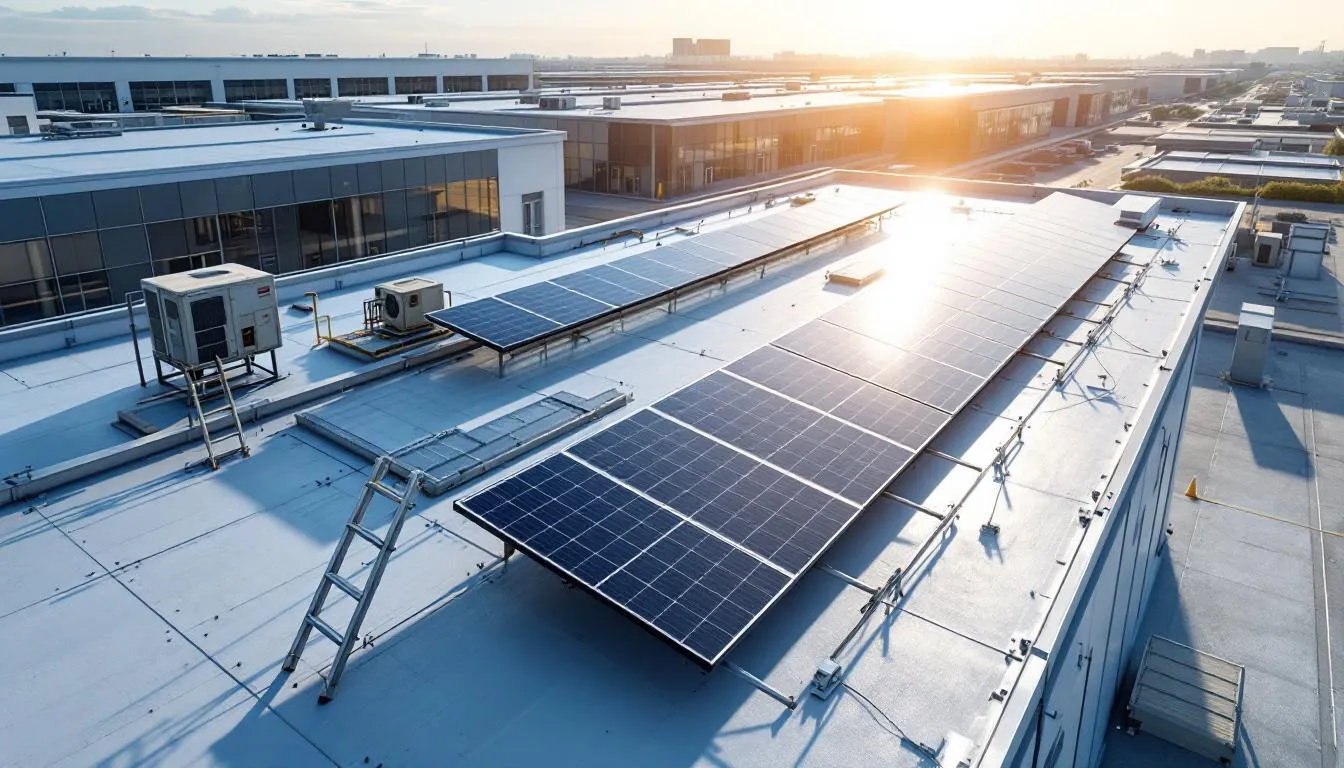
Industrial Flex Space Roofing in Austin, TX
Flex Roofs Carry More Penetrations Than Any Building We Service in Austin
Industrial flex space is the workhorse of Austin's commercial inventory, and its roofs prove it. A single low-slope deck might cover a CNC shop, a creative studio, a craft brewery, and a third-party logistics tenant, each with its own rooftop equipment punched through the membrane. We spend our days on these buildings up and down Burnet Road, throughout the McNeil and Kramer Lane corridors near the old IBM campus, and across the dense flex parks east of US-183 in the Montopolis and Springdale areas. What ties them together is penetration count. Where a single-tenant warehouse might have a dozen roof curbs, a 40,000-square-foot flex building can carry sixty or more: condensers, exhaust fans, gas lines, conduit racks, plumbing vents, and rooftop units that change every time a tenant moves out and a new one builds out.
Every one of those penetrations is a seam, and every seam is a place water looks for. We treat the flex roof as a field of details rather than a flat plane, because that is how it actually behaves and that is where it actually fails.
What Multi-Tenant Roofing Demands That Single-Tenant Work Does Not
The hardest part of a flex roof is not the membrane. It is the constant churn above it. A tenant signs a lease, a contractor sets a new RTU on a fresh curb, and six penetrations appear that were never on the original roof plan. The next tenant relocates a server room and abandons the old condenser, leaving a capped curb and a patch. Over a few lease cycles, the roof becomes a patchwork of details installed by whoever was cheapest that month, and the building owner inherits all of it.
We approach Austin flex buildings with that reality in mind. Before we quote anything, we map the roof tenant by tenant and document who owns which unit, which curbs are live, and which are abandoned. Abandoned penetrations get cut out and properly infilled with new deck and membrane, not capped and forgotten. Live equipment gets flashed to current standards. We coordinate access so a brewery's walk-in cooler condenser and a print shop's makeup-air unit do not both get disturbed on the same day without warning.
- Tenant-improvement penetrations that were field-cut without proper curbs or counterflashing
- Abandoned curbs from departed tenants that trap water and hide rot in the deck below
- Mismatched membrane patches where prior repairs used incompatible materials over the original roof
- Overloaded structural bays where equipment was added without confirming the deck could carry it
- Shared drainage that lets one tenant's ponding become the whole building's problem
Drainage and Ponding on Austin's Big Flat Decks
Most Austin flex buildings were built fast and built flat, often with minimal slope and internal roof drains rather than perimeter scuppers. When the spring storms roll up out of the Hill Country and dump two or three inches in an afternoon, those drains have to move water immediately. We see ponding concentrate around the heaviest equipment clusters, where the deck has deflected slightly under load and water collects against curb walls. Standing water is not just a membrane problem in this climate; it is a structural one, because a flooded low spot adds weight that deepens the deflection that caused the pond in the first place.
We address drainage as part of any reroof or major repair. That means clearing and re-flashing existing drains, adding tapered insulation crickets to divert water around equipment, and where the building justifies it, cutting in overflow scuppers so a clogged drain during a downpour does not turn the roof into a reservoir. On buildings near Onion Creek and the lower Colorado floodplain, where we have watched genuinely heavy rain events, this matters more than the membrane brand.
Heat, UV, and the Long Austin Summer
From May through September, an Austin flex roof bakes. Dark or aged membranes routinely run far hotter than the air temperature, and that heat drives the cooling load for every tenant underneath. For multi-tenant buildings where the owner often pays common-area power and tenants pay their own, a reflective roof is one of the few upgrades that benefits everyone. We favor light-colored single-ply systems and reflective coatings on flex buildings precisely because the energy savings get spread across the whole rent roll, and because cooler membranes age far more slowly under our relentless UV.
Systems We Install on Austin Flex Buildings
There is no single right roof for flex space, because the buildings vary so much. What we choose depends on the deck, the existing system, the penetration density, and how long the owner intends to hold the asset.
- TPO and PVC single-ply for their reflectivity and the ease of fabricating clean flashings around dozens of penetrations
- Roof coatings and restoration where the existing membrane is sound but weathered, extending service life without a tear-off and without disrupting tenants
- Modified bitumen on buildings with heavy foot traffic from constant equipment servicing, where a more rugged surface holds up better
- Recover systems that go over an existing roof where the deck is dry and structurally sound, avoiding tear-off cost and tenant downtime
We are candid about which approach fits. If a restoration coating buys an owner five solid years before a planned sale, we will say so rather than pushing a full system the building does not need yet.
Working Around Tenants Who Cannot Stop Working
A flex building never fully closes. The logistics tenant ships at six in the morning, the fabricator runs a second shift, and the brewery's taproom fills on weekends. We schedule loud and disruptive work in coordination with the property manager, stage materials so we do not block loading docks, and protect the active areas below whenever we open up a section of deck. For tenants running sensitive equipment or clean processes, we contain debris and seal openings at the end of each day so nothing rains down into a workspace overnight.
Maintenance Keeps a Flex Roof From Becoming a Liability
The single biggest reason Austin flex roofs fail early is neglect between tenant turns. Nobody owns the roof day to day, so nobody walks it until a tenant reports a leak over their inventory. By then the deck is often already wet. We put flex buildings on a maintenance schedule tailored to their lease cycles, inspecting after every major tenant build-out and at least twice a year otherwise, before and after storm season.
Our inspections focus on the details that actually fail: pitch pans drying out and cracking, sealant at counterflashings letting go, drains backing up with debris from the surrounding live oaks, and new penetrations that a tenant's contractor installed without telling anyone. We document everything with photos tied to roof locations, so an owner managing a building from across town or out of state knows exactly what shape the asset is in.
If you own or manage flex space anywhere from the Domain-adjacent corridors to the Southeast industrial district, we will walk your roof, give you an honest read on what it needs now versus what can wait, and lay out a plan that fits how the building is actually used. Reach out and we will get on the roof.
Leak points, drainage, seams, penetrations, edge metal, roof access, and interior risk should be clear before the next roof decision is priced.
Immediate repair, maintenance, coating, recover, and replacement choices should be measured against roof age, moisture risk, tenant disruption, and budget timing.
A site visit is useful when the owner needs a documented roof condition, active leak response, storm review, or a clearer capital plan.