
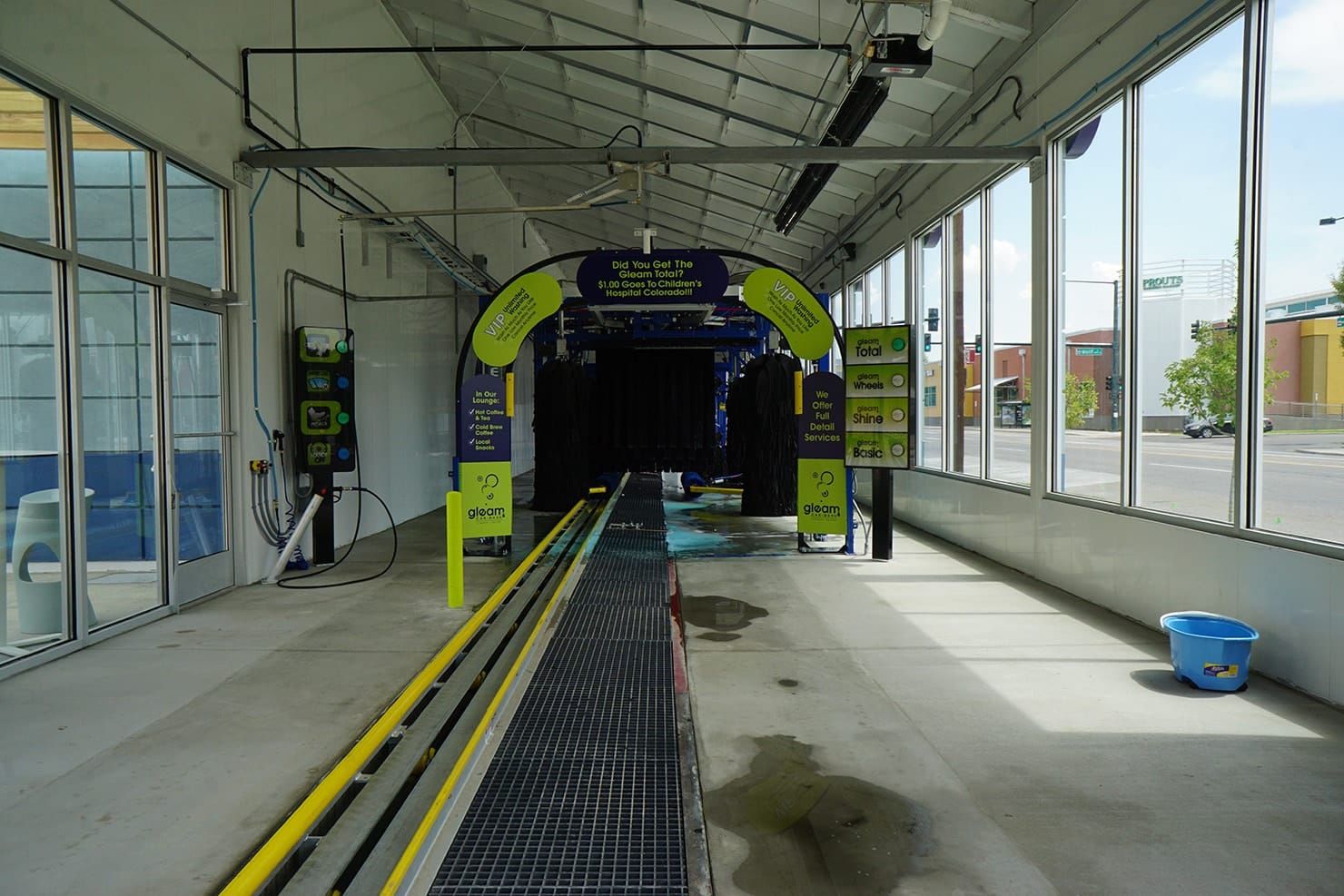
Car Wash Roofing in Austin, TX
Roofing Built for Austin Car Washes
A car wash is one of the hardest working roofs we put a crew on. Below the deck, hot water hits cold concrete all day, soaps and tire-shine compounds turn to vapor, and the air inside a tunnel bay rarely drops below saturation. Above the deck, a Central Texas summer pushes membrane surface temperatures well past 150 degrees. That combination quietly cooks a roof from both sides, and most operators do not notice until a fastener backs out or a seam opens over the equipment room.
We build and maintain low-slope roofs for express tunnels, self-serve bays, and full-service washes across the Austin metro. Our work is grounded in one fact that generic roofers miss: the threat to a car wash roof usually starts on the inside, not the sky.
Why Car Wash Roofs Fail From Below
Warm, chemical-laden air rises and looks for the coldest surface it can find. On a car wash, that surface is the underside of the steel or wood deck. Water vapor condenses there in a thin film, and that film carries the same surfactants, hydrofluoric wheel cleaners, and chlorinated drying agents that are sprayed on cars all day. Over a few seasons it corrodes deck flutes, eats the coating off fasteners, and rots the top layer of a plywood deck so screws lose their grip.
By the time the membrane on top shows a problem, the real damage is in the assembly. We have pulled fasteners out of tunnel-bay decks in this market that came up with no threads left at all. That is why every car wash roof we design starts with a vapor strategy, not a membrane brand.
- A continuous, sealed vapor retarder over the deck so interior moisture cannot reach the insulation
- Closed-cell polyiso that does not wick or hold water if the retarder is ever breached
- Stainless or heavily coated fasteners and plates rated for a corrosive interior, not standard galvanized
- Mechanical exhaust coordination so the building is not pushing humid air straight into the deck
Membranes We Trust Over Wash Bays
For most Austin washes we specify a thick PVC or KEE single-ply membrane. PVC stands up to the grease, detergents, and animal fats that land on a car wash roof far better than EPDM, which can swell and soften where it meets oils. We hot-air weld every seam into a single monolithic sheet, then reinforce the field around every exhaust fan, blower stack, and reclaim-tank vent, because those penetrations are where humid interior air finds its way out and weather finds its way in.
On washes with heavy rooftop equipment or a reclaim system mounted up top, we sometimes move to a reinforced TPO or a redundant two-ply approach. The decision comes after we open the roof and see what the deck is actually doing, not before.
Built for Central Texas Weather
Austin sits in the heart of Texas hail alley, and the storms that roll off the Hill Country in spring routinely drop large stones on flat commercial roofs along I-35 and US-183. A car wash roof also lives under standing-water risk: gentle slopes plus clogged drains plus a flat summer means ponding, and ponding over a humid bay accelerates everything we described above. We build positive drainage into the design, add tapered insulation where the deck has gone flat, and use impact-rated membranes on exposed sites.
The 2021 winter freeze taught every Austin operator that water lines and roof drains can rupture in ways nobody planned for. When we reroof a wash, we pressure-test the internal drains and overflow scuppers so a hard freeze does not turn into an interior flood over your pumps and dryers.
Where Austin's Car Washes Are Growing
Express tunnels have multiplied along the high-traffic suburban corridors feeding Austin's growth. We see steady demand around the retail strips of South Lamar and Ben White Boulevard, along the US-290 and US-183 commuter routes, near the booming rooftops of Southpark Meadows in far South Austin, and out along the I-35 frontage through Round Rock and Pflugerville where new subdivisions keep arriving. The Domain area and the tech campuses up the MoPac corridor have pushed dense daytime traffic north, and wash operators have followed it. Each of these submarkets puts a wash on a tight pad site where a roof failure shuts the whole tunnel down, so uptime is everything.
How We Keep a Wash Open During the Work
A car wash that closes for a reroof is bleeding revenue every hour. We sequence the work so your tunnel keeps running wherever the structure allows, stage materials off-peak, and protect the conveyor, pay stations, and vacuum islands from debris. When we have to tie into live exhaust or blower curbs, we schedule those cut-overs around your slow windows so the bay is never down during a Saturday rush.
The Equipment Room Is the First Place We Look
On nearly every wash we inspect, the earliest evidence of roof trouble shows up over the equipment and pump room rather than the tunnel itself. That space holds the warmest, most chemically active air in the building, and it usually has the most penetrations crowded into a small footprint: blower stacks, control conduit, water-heater flues, and reclaim vents all punching through one corner of the deck. When those penetrations are flashed with nothing more than caulk, the daily heat cycle works the sealant loose and the humid interior air does the rest. We rebuild those details with proper sealed boots and welded target patches so the busiest corner of your roof stops being the weakest one.
We also check the parapet and wall transitions, because a tunnel wash often shares a wall with a retail bay or office, and the flashing where the low roof meets that taller wall is a classic leak path once Central Texas wind drives rain sideways into it.
A Maintenance Plan That Pays for Itself
Because a wash roof is under constant chemical and humidity stress, it rewards regular attention more than almost any other building we service. Twice-a-year inspections let us catch a lifting fastener, a clogged drain, or a softening seam while it is still a quick repair instead of a tear-off. We clear drains before the spring storm season, reseat any fasteners that have started to back out, and document the membrane condition so you know exactly how much life is left before you have to budget for replacement. For a single-pad operation where one leak can idle the whole tunnel, that kind of schedule is the cheapest insurance you can buy.
- A roof assessment that looks at the deck underside and interior humidity, not just the top surface
- A written scope naming the exact membrane, insulation, vapor retarder, and fasteners we will install
- Detailing based on every blower, exhaust fan, and reclaim vent on the roof
- Drainage corrected so water leaves the roof instead of sitting over your equipment
- Scheduling that keeps the tunnel earning while we work
If you run a wash anywhere in the Austin area and you are seeing rust streaks, ceiling stains over the equipment room, or fasteners that have started to lift, the problem is almost certainly the humidity cycle eating your assembly from the inside. Call us and we will get up there, open it up, and tell you exactly what your roof needs.
Leak points, drainage, seams, penetrations, edge metal, roof access, and interior risk should be clear before the next roof decision is priced.
Immediate repair, maintenance, coating, recover, and replacement choices should be measured against roof age, moisture risk, tenant disruption, and budget timing.
A site visit is useful when the owner needs a documented roof condition, active leak response, storm review, or a clearer capital plan.