
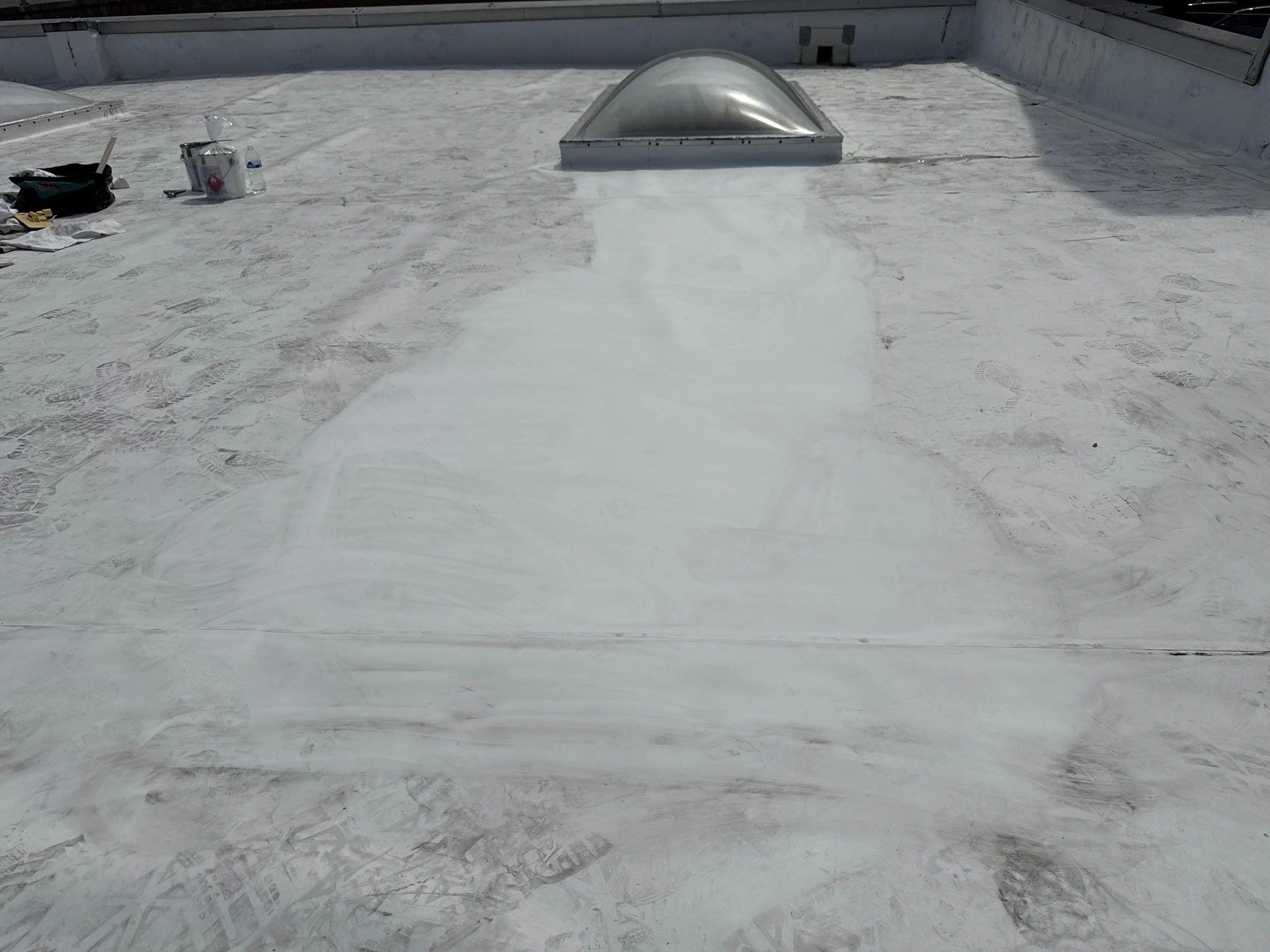
Roof Recover Systems in Austin, TX
A properly executed recover extends a commercial flat roof's service life 15 to 20 years at roughly half the cost of full replacement, when the substrate qualifies. Getting that qualification right is the whole job.
A roof recover installs a new roofing system directly over the existing assembly without tear-off, leaving the old membrane and insulation in place. When the substrate qualifies, dry insulation, sound deck, functional drains, recover eliminates disposal costs, reduces production time, and extends asset life at materially lower capital cost than full replacement. When the substrate does not qualify, a recover traps problems below the new system and accelerates failure.
In the Austin market, the recover decision is complicated by the city's construction history. Many commercial buildings in the 78741, 78745, and 78753 zip codes were built in the 1970s and 1980s with BUR systems over poured gypsum or concrete decks. Those buildings may have received one or more prior recovers, which affects both the code allowance for additional assemblies and the deck's structural capacity for added dead load. Buildings in the Domain and North Austin tech corridor from the 2000s and early 2010s often have single-ply systems approaching their first recover window, a different situation with different substrate dynamics.
We assess recover candidates the same way we assess replacement candidates: moisture core sampling, drain condition, flashing condition, deck condition at core locations, and a review of the building's permit history to confirm prior assembly count. The written report we deliver distinguishes honest recover candidates from buildings that need replacement, and it gives the numbers that support the capital decision rather than defaulting to whichever option is easier to sell.
Recover System Options and Substrate Compatibility
TPO or EPDM single-ply recover over existing BUR, modified bitumen, or aged single-ply is the most common recover path on Austin commercial buildings. The new membrane is mechanically fastened or adhered to a cover board installed over the existing assembly. Cover board, typically HD polyiso or gypsum board, provides a smooth fastening substrate, separates the new membrane from the irregular surface of the old assembly, and provides thermal break at fastener locations. Without a cover board, the new membrane conforms to every ridge and valley in the old surface and creates stress concentrations at weld seams.
Modified bitumen cap sheet recover over existing BUR is appropriate when the BUR surface is structurally sound and the building owner wants a lower first-cost option. Torch-applied or cold-adhesive SBS modified bitumen bonds to clean, primed BUR surfaces and carries manufacturer warranties of 10 to 15 years. This is a transitional solution, a 10-year bridge to a more complete replacement cycle, not a 20-year asset extension.
Spray polyurethane foam (SPF) recover is used on irregular or multi-level roofs where self-leveling capability is needed to address slope and drainage without a tear-off. SPF is applied as a liquid that expands and cures in place, then coated with silicone or acrylic topcoat. Austin's heat and UV environment make topcoat selection critical for SPF, uncoated foam degrades quickly in direct sun. We assess SPF recover on a case-by-case basis and specify topcoat mil thickness for the building's specific exposure.
Code and Structural Considerations for Austin Recover Projects
The IBC limits commercial roof assemblies to two roofing systems before full tear-off is required. The City of Austin Development Services Department enforces this through the permitting process. Before recommending recover on any Austin commercial building, we verify the prior assembly count through permit records or physical core inspection. A building at its assembly limit needs full replacement regardless of insulation condition.
Dead load is the structural consideration on recover. A single-ply recover with cover board adds approximately 1.5 to 2.5 pounds per square foot to the existing assembly. A BUR recover with modified bitumen cap sheet adds more. Most Austin commercial buildings designed after 1980 have structural capacity to support one recover without engineering review. Pre-1960 construction or buildings with visible deck deflection get a structural review recommendation before we scope any recover option.
Drain elevation is the practical constraint that kills the most Austin recover proposals. If the existing assembly is already flush with parapet height or at the drain's maximum receivable depth, an additional assembly layer will hold water above the drain, creating persistent ponding that no membrane can indefinitely resist. We measure drain depth and parapet height during the assessment walk, drain riser modification is sometimes available, but it is a cost item that needs to be in the scope before the recover contract is signed.
Recover Warranty and Manufacturer Requirements
Manufacturer warranties on recover systems run 10 to 20 years depending on the system and the substrate documentation. Most major TPO and EPDM manufacturers require: written core sampling data confirming dry insulation, a permit from the City of Austin or the applicable municipality, and a field inspection by the manufacturer's representative at closeout. We provide all three as part of standard recover closeout.
Some manufacturer NDL (no-dollar-limit) warranty programs do not cover recover applications, they require full replacement on virgin substrate for NDL qualification. If NDL warranty is a requirement for the property's insurance or financing, we confirm warranty path before the recover scope is finalized. In some cases, the NDL requirement tips the economic analysis toward replacement even when recover would otherwise be viable.
Post-recover maintenance requirements are identical to post-replacement requirements for the same system: annual inspection, drain clearing, sealant renewal at penetrations. We offer maintenance contracts structured to each manufacturer's warranty terms, not a generic annual visit that satisfies no one's written requirement.
How do you determine if my Austin building's roof qualifies for recover?
Three data points determine qualification: moisture core results (dry insulation is required), drain elevation relative to parapet height (there must be room for another assembly layer without chronic ponding), and prior assembly count (IBC allows maximum two roofing systems before required tear-off). We collect all three during the assessment walk and report in writing. If any of the three fail, we recommend the least disruptive corrective path, targeted wet-zone replacement before recover, drain riser modification, or full tear-off, depending on what the data shows.
Does recover cost significantly less than replacement on Austin commercial roofs?
On large roofs, yes. The savings come from eliminating tear-off labor and the disposal cost of the old assembly, particularly significant on BUR roofs where aggregate-surfaced material weighs 7 to 10 pounds per square foot. On a 100,000-square-foot BUR roof, that disposal differential can be substantial at Austin landfill tipping fee rates. On smaller roofs, the savings are proportionally smaller and the additional dead load assessment cost can close the gap. We run the numbers in the written assessment.
Can a recover be done in phases on a large Austin commercial building?
Yes, and it is often the right approach on buildings over 100,000 square feet. Phased recover sequences the work in sections large enough to be economically efficient but small enough to complete dry-in within a single production day, critical given Austin's spring storm season. Each phase needs its own dry-in detail at the phase boundary, which adds cost but is the responsible approach for occupied buildings where an overnight opening would be unacceptable.
Get a recover qualification assessment for your Austin building.
Our project managers will pull cores, check drain elevations, verify prior assembly count, and deliver a written recommendation on whether recover is the honest option for your building.
Leak points, drainage, seams, penetrations, edge metal, roof access, and interior risk should be clear before the next roof decision is priced.
Immediate repair, maintenance, coating, recover, and replacement choices should be measured against roof age, moisture risk, tenant disruption, and budget timing.
A site visit is useful when the owner needs a documented roof condition, active leak response, storm review, or a clearer capital plan.