
Roof Maintenance Program Management in Austin, TX
Inspection Cadence and What Each Visit Covers
Standard maintenance programs run two inspections per year, spring and fall, timed to bookend Austin's most active weather periods. Spring inspection is scheduled in March or April before the prime convective storm season that peaks in May and June. The Memorial Day 2015 floods and the recurring May hail events across the Austin MSA are the reference events that make pre-storm inspection worth the cost. Fall inspection is scheduled in October after the heat season and before the winter fronts that drive thermal cycling at parapet flashings.
Each spring inspection covers: drain strainer condition and clearing, sealant condition at all penetrations and terminations, membrane surface for UV chalking or surface erosion above normal age-range, parapet cap condition, any ponding area from the winter period, and rooftop equipment, HVAC curbs, conduit penetrations, antenna mounts, for movement or settlement that may have opened a flashing gap.
Each fall inspection covers: post-storm membrane surface for puncture or impact damage, seam edges for delamination at areas with high thermal cycling, flashing condition after summer heat exposure, drain flow rate, and a photographic update to the zone diagram. On buildings with active manufacturer warranties, fall inspection submission timing aligns with the manufacturer's required annual report window.
Buildings with specific conditions, active restaurant kitchen exhaust penetrations, heavy rooftop mechanical equipment, or roofs in the hail corridor north of US 183, get additional inspection points written into their maintenance program at enrollment.
Preventive Work Included in Each Visit
An inspection without preventive work is just documentation. Each maintenance visit includes: drain strainer clearing at all accessible interior drains and scuppers, sealant renewal at penetrations and terminations where the existing sealant shows cracking or separation but the underlying flashing is sound, minor membrane repair at surface punctures under one square foot, and debris clearing at ponding areas that would restrict drain flow.
Sealant renewal is the highest-frequency preventive task on Austin commercial roofs. Silicone and polyurethane sealants at penetration terminations and parapet cap joints have a realistic service life of five to seven years in Austin's UV environment, shorter on west-facing exposures and south-facing parapets that receive maximum sun load. We renew sealant proactively on a zone rotation so no area of the roof exceeds eight years without renewal, rather than waiting for sealant failure to produce a leak before the repair happens.
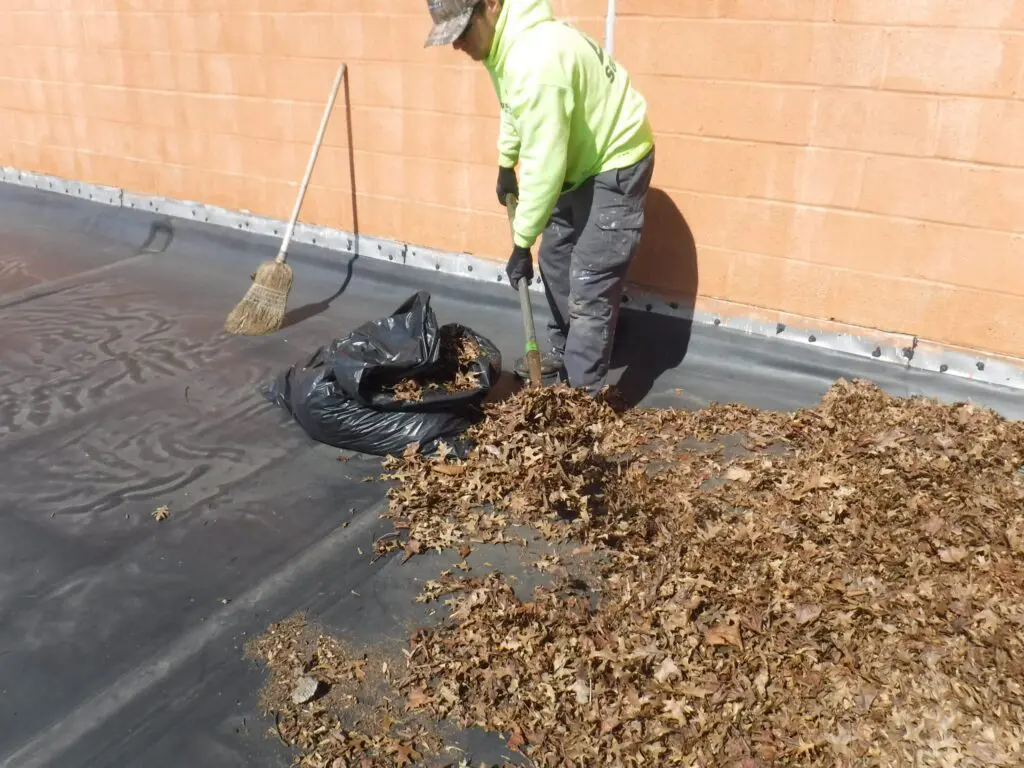
Drain clearing is particularly relevant on Austin roofs in spring. The cedar and live oak pollen season in February through April, the notorious cedar fever season in Austin, produces significant organic debris accumulation on flat roofs that clogs drain strainers faster than in drier or less vegetated markets. A clogged strainer during a May convective event can produce roof ponding that exceeds the drain elevation and backs up into the building. We clear drains in late March on every building in our maintenance program.
Repair Priority Queue and Capital Planning Interface
After each inspection, we update the repair priority queue: items are classified by urgency, repair immediately before next rain event, repair within 30 days, monitor at next inspection, or log for capital planning inclusion. The queue is delivered to the building owner in the inspection report and updated as repairs are completed.
The annual condition report synthesizes the year's inspection findings into a roof age and condition rating, a projected remaining service life range, and a preliminary scope for the next major capital event, whether that is a large-scale repair campaign, a coating application to extend membrane life, or a full replacement. This gives the building owner's capital planning process a defensible basis, not 'the roof is getting old' but 'the insulation cores from March show 12% saturation in the northwest zone, projected replacement window is two to four years, estimated capital range is $X to $Y at current pricing.'
For multi-building portfolios, common among Austin REITs, the city's hospital systems including Ascension Seton and St. David's HealthCare, and the large property management companies that manage the Domain-area office inventory, we produce a portfolio summary that ranks each building's replacement urgency and consolidates the capital projections into a single budget-planning document.
How does a maintenance program affect my roof's warranty?
Most manufacturer NDL warranties require documented annual maintenance to remain in force. Our maintenance program is structured to satisfy that requirement, the annual inspection report submitted to the manufacturer is part of the program's deliverable. If a building comes to us after the warranty maintenance lapsed, we can often reinstate coverage through a manufacturer reinspection process.
Can you take over a maintenance program that a previous contractor was managing?
Yes. We request the prior contractor's inspection records and any manufacturer warranty correspondence, review the history, and establish a current baseline condition report. The transition is typically straightforward. The only complication is when prior records do not exist, in that case, we start with a fresh baseline inspection and note the gap in the documentation file.
What does a maintenance program cost relative to deferred maintenance on Austin commercial roofs?
The return on maintenance investment on Austin commercial roofs is well-documented: proactive sealant renewal and drain clearing prevents leak events that typically cost 10 to 20 times the annual maintenance fee in interior damage remediation, tenant disruption, and emergency repair. We are not the right party to quantify this for a specific building, but the comparison between preventive maintenance cost and reactive leak response cost is not close.
Set up a maintenance program for your Austin commercial roof.
We structure the inspection cadence, preventive work, and reporting around your building's specific system and warranty requirements, not a generic service contract.
Leak points, drainage, seams, penetrations, edge metal, roof access, and interior risk should be clear before the next roof decision is priced.
Immediate repair, maintenance, coating, recover, and replacement choices should be measured against roof age, moisture risk, tenant disruption, and budget timing.
A site visit is useful when the owner needs a documented roof condition, active leak response, storm review, or a clearer capital plan.