
Commercial Solar Roof Integration in Austin, TX
Putting Solar on a Commercial Roof in Austin Without Voiding the Warranty
Adding a rooftop solar array to a commercial building in Austin is two projects pretending to be one. There is the photovoltaic project, run by your solar EPC, and there is the roofing project that quietly underpins it. We get called when those two scopes were never coordinated, and the result is a roof full of racking penetrations that nobody on the roofing side ever signed off on. Our work on solar-ready roofs is about making the membrane and the array behave as a single assembly, so the panels you install to fight Austin's brutal summer power bills do not become the reason your roof starts leaking three years later.
The demand drivers here are specific. Austin Energy's tiered summer rates and its commercial solar incentives have pushed a lot of property owners along the US-183 tech corridor and out toward the Samsung and semiconductor build-out north of Taylor to look hard at on-site generation. Distribution and flex buildings in the Walnut Creek and McKalla industrial pockets have acres of flat low-slope roof and high daytime load, which is close to an ideal candidate for rooftop PV. Office and mixed-use towers around the Domain and along the MoPac (Loop 1) corridor are doing the same math for ESG reasons. Almost all of those roofs are single-ply membrane, and almost none were designed assuming a few hundred racking feet would be fastened or ballasted on top of them.
Racking Penetrations Are the Whole Ballgame
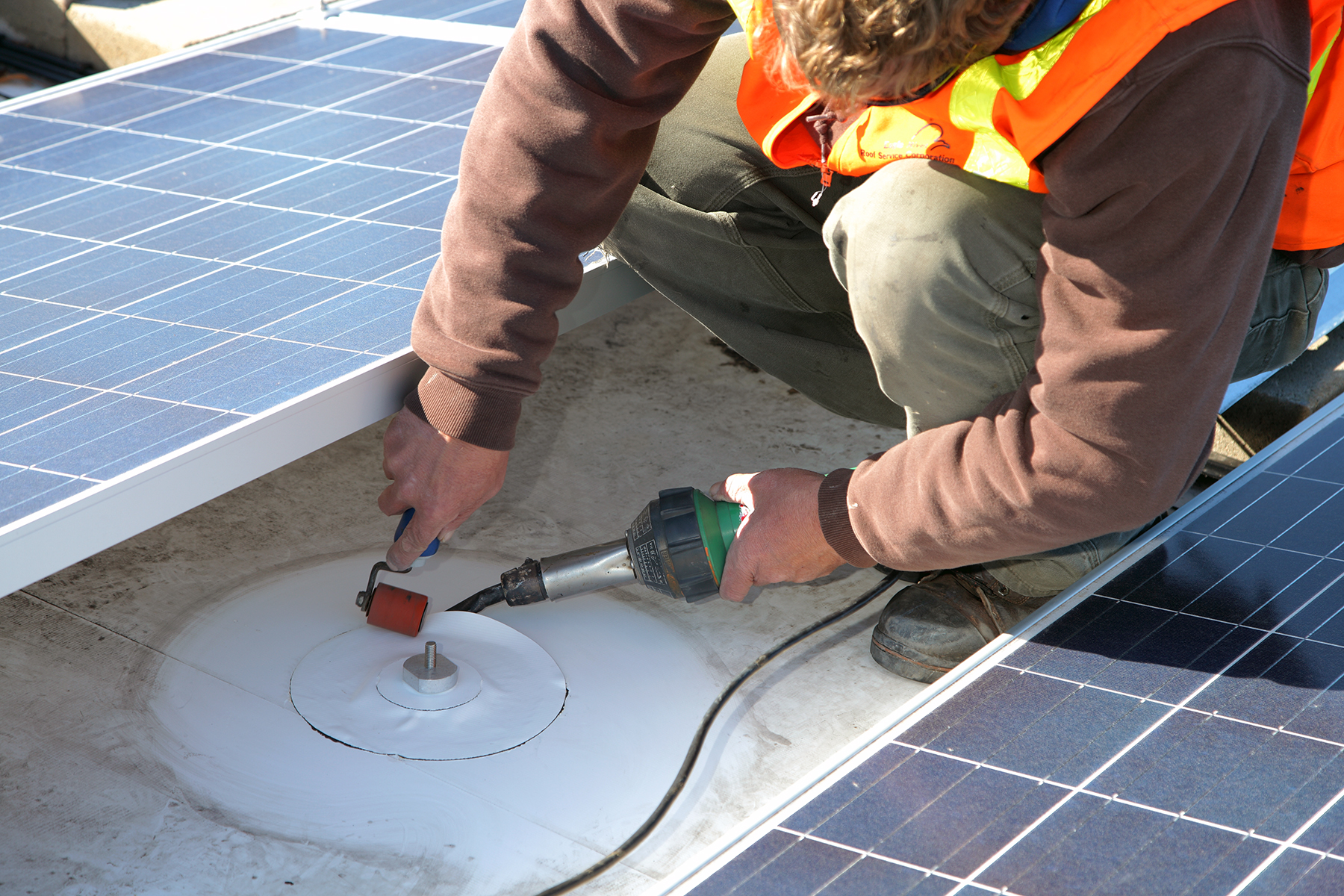
Most commercial racking systems attach one of two ways: mechanically fastened stanchions that screw through the membrane into the deck, or ballasted trays that sit on the roof and rely on weight to resist wind. Each approach fails differently when the roofer is not in the room. With mechanically attached racking, every stanchion is a deliberate hole in your waterproofing. Done right, that penetration gets a manufacturer-approved flashing or a hot-air-welded membrane boot tied back into the field sheet. Done by a solar crew with a tube of sealant, it becomes a slow drip that tracks under the membrane and shows up as a ceiling stain twenty feet away. We set, flash, and weld every penetration to the membrane manufacturer's detail so the roof system stays watertight and the array has solid attachment.
Ballasted systems avoid penetrations but trade that problem for a loading problem, which on an Austin roof is really a wind problem. Our convective storm season drives strong gust fronts and microbursts, and a ballasted array that pencils out on paper can still walk or lift if the ballast layout was never reconciled with the roof's actual wind zones and parapet heights. We coordinate slip sheets and protection mats under ballast pads so the panels' point loads do not abrade or indent the membrane, and we verify the layout against the perimeter and corner uplift zones where Austin's gusts concentrate.
Membrane Compatibility and Heat
Not every membrane wants solar on it, and not every component the solar crew brings is compatible with your roof. TPO and PVC are the common single-plies under Austin arrays, and they are generally good hosts, but the protection mats, walk pads, and any adhered components have to be chemically compatible with that specific sheet. Drop an incompatible plasticized pad on a PVC roof and you can get plasticizer migration that degrades the membrane right where the array sits. EPDM has its own compatibility rules. We confirm every accessory against the membrane manufacturer's approved list before anything touches the roof.
Heat is the other quiet factor. An array changes the thermal picture of the roof beneath it. Texas-grade UV and surface temperatures are already among the hardest service conditions a membrane sees in the country, and the gap under the panels traps heat while shading other areas, creating differential aging and movement across the same roof. We account for that when we detail the field and the penetrations, because a roof that bakes unevenly moves unevenly, and movement is what opens seams.
Weight, Uplift, and the Numbers That Actually Matter
Before any panels go up, somebody has to answer whether the structure can carry them and whether the array will stay put in a storm. The dead load of a ballasted system is real weight added to a deck that was designed decades ago for a flex or warehouse use along East Austin's St. Elmo district or the SH-71 logistics zone near the airport. We work with the structural engineer of record and the solar EPC so the added dead load and the uplift resistance are both verified, not assumed. Uplift is the half that gets skipped most often, because it is invisible until the day it is not. We make sure the attachment or ballast scheme matches the building's exposure and the corner and edge zones where Austin wind pressures spike.
- Confirm structural capacity for ballast and equipment dead load with the engineer of record before procurement.
- Verify uplift resistance against the building's wind zones, parapet conditions, and exposure category.
- Lay out ballast and attachment to keep concentrated point loads off vulnerable seams and flashings.
- Detail every roof penetration to the membrane manufacturer's published flashing standard.
Coordinating the Roofer and the Solar Installer
The single most useful thing we do on these jobs is sit between the roofing manufacturer's warranty and the solar contractor's installation. Membrane manufacturers will not honor a watertightness warranty on penetrations made by an uncertified crew using unapproved details. That means the moment a solar EPC fastens racking through your TPO without a certified roofer involved, you can lose the warranty on the entire roof, not just the spots they touched. We keep that from happening by performing or directly supervising every membrane penetration and flashing so the work stays inside the manufacturer's program and your no-dollar-limit warranty survives the install.
Sequencing on an Occupied Building
Most Austin commercial buildings taking on solar are fully occupied during the work, whether it is a downtown office tower in the central business district or an operating distribution center off US-183. We sequence the roofing scope around the array installation so the deck is never left open and so penetration flashing happens in the right order relative to racking placement. That coordination matters most at the tie-ins, where the array's electrical conduit and equipment pads cross the field of the roof and create their own family of penetrations that all need the same disciplined detailing.
Roof Age Is the Decision Point
The hardest conversation is timing. A solar array is a twenty-five-year asset. If your membrane has eight years of service life left, mounting a long-life array on a short-life roof guarantees an expensive teardown and re-install of the panels mid-life just to replace the membrane underneath. We give property owners an honest read on remaining roof life before the array goes up, because the right move is sometimes to recover or replace the roof first and mount the solar on a fresh substrate. That sequencing decision, made early, is usually the difference between a clean twenty-five-year run and a costly mid-life rework.
How We Approach Solar-Ready Roofing
We start by reviewing the array design, the racking attachment method, and the membrane specification together, then we walk the roof to confirm its actual condition and remaining life. From there we coordinate the penetration and flashing details with the membrane manufacturer, align the loading and uplift questions with the structural engineer and the solar EPC, and define who is responsible for which scope in writing. During installation we perform or supervise the waterproofing work, and when it is done we provide documentation that keeps the roofing warranty intact. The goal is a building where the solar array and the roof were planned as one system, so the energy savings you signed up for never get eaten by a roof problem nobody coordinated.
If you are weighing a rooftop solar project on a commercial building anywhere from the Domain to the St. Elmo district to the airport-area logistics corridors, talk to us before the racking gets ordered. The earlier we are involved, the cheaper and cleaner the whole project gets.
Leak points, drainage, seams, penetrations, edge metal, roof access, and interior risk should be clear before the next roof decision is priced.
Immediate repair, maintenance, coating, recover, and replacement choices should be measured against roof age, moisture risk, tenant disruption, and budget timing.
A site visit is useful when the owner needs a documented roof condition, active leak response, storm review, or a clearer capital plan.