
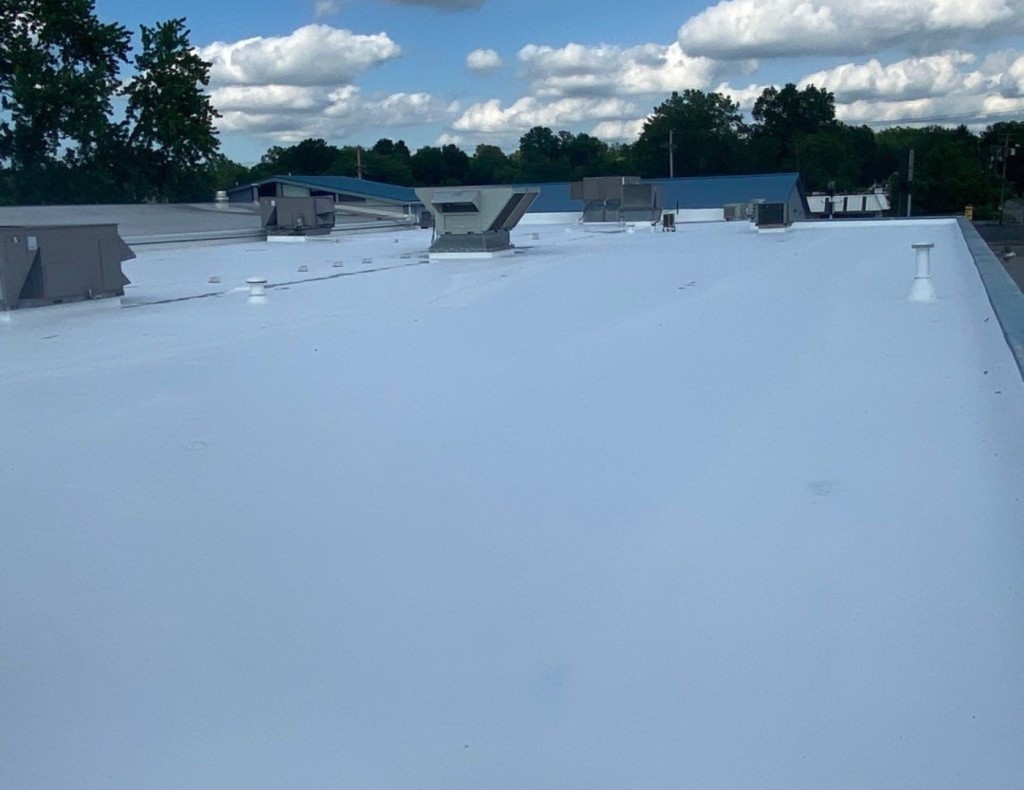
Single Ply Roofing in Austin, TX
East Austin and the Mueller district: The Mueller redevelopment on the former Robert Mueller Municipal Airport site, 700 acres of mixed-use development built between 2010 and 2020, has a commercial and office inventory with roof systems at or approaching the first major maintenance threshold. Most Mueller commercial buildings have TPO systems. The older East Austin warehouse corridor, Airport Boulevard and the industrial pockets between I-35 and US 183, has a mix of BUR, modified bitumen, and older single-ply that is approaching or past end of life.
Georgetown and the Samsung Taylor corridor: Samsung's advanced semiconductor fabrication plant in Taylor, northeast of Georgetown, is one of the largest industrial construction projects in Texas history. The broader Williamson County industrial market is expanding around this anchor. New and planned industrial buildings in this corridor need single-ply specifications that account for the documented hail frequency in this part of the Austin MSA and for the institutional reporting requirements of large-format manufacturing clients.
Wind Uplift and Code Compliance for Austin Single-Ply
IBC 2021 wind uplift requirements apply to all commercial roofing in Austin and across the Texas Hill Country. The required fastener pattern, insulation attachment, and membrane attachment are functions of the building's Exposure Category (A, B, or C), Risk Category, and zone location on the roof (field, perimeter, corner). Buildings on open terrain near the Balcones Escarpment or on elevated ground in the western Austin market have higher uplift requirements than buildings in the sheltered interior submarket terrain.
Mechanically fastened single-ply, the dominant installation method for new commercial construction in the Austin MSA, relies on the fastener pullout resistance of the structural deck. We test fastener pullout resistance on any deck that shows corrosion, deterioration, or where the documented deck gauge is below the specification. Installing a single-ply system over a deck with insufficient fastener resistance produces uplift failure in the first significant wind event, a failure mode that is both catastrophic and entirely preventable.
Permit documentation for Austin commercial single-ply projects requires wind uplift calculations and an engineer-of-record sign-off on any project above a certain roof area or building height threshold. We manage the permit documentation as part of project setup. The City of Austin Development Services Department and the municipal permit offices in Round Rock, Georgetown, Pflugerville, and Cedar Park each have slightly different permit requirements and timelines, we track the current requirements for each jurisdiction and do not ask building owners to navigate the permit process independently.
What is the most common single-ply membrane installed on Austin commercial roofs?
TPO is the most-installed commercial single-ply membrane in the Austin MSA, as it is in most U.S. markets. Its white reflective surface meets IECC 2021 Solar Reflectance Index requirements without additional insulation upgrades, 20-year NDL warranties are widely available from major manufacturers, and its material and installation cost is competitive at commercial scale. PVC is specified for chemical-exposure applications; EPDM is specified for specific industrial and manufacturing use cases.
How long does single-ply roofing last in Austin's climate?
A properly installed 60-mil TPO or PVC system with a 20-year NDL warranty has an expected service life of 20 to 25 years with consistent maintenance. Austin's UV load and summer surface temperatures accelerate surface degradation relative to cooler climates, the first recoat or restorative coating is typically appropriate in the 12 to 15 year range depending on membrane brand and maintenance history. EPDM can run 20 to 30 years with consistent maintenance because its chemistry is more inherently UV-stable than thermoplastic membranes.
Can different single-ply membranes be combined on the same roof?
Generally no, different single-ply chemistries are not compatible at seams. TPO and PVC can be heat-welded to each other in some circumstances, but this is atypical and requires verification with the membrane manufacturers involved. EPDM is not compatible with TPO or PVC at the seam. On a building where different zones have different membrane specifications, for example, a grease-exposed zone near exhaust equipment requiring PVC and the general field requiring TPO, the two zones are separated by a dividing termination bar, not blended at a seam.
Get a single-ply recommendation for your Austin commercial building.
We will walk the roof, document the building use and exposure conditions, and deliver a written membrane recommendation with system specification and warranty path, before any bid.
Leak points, drainage, seams, penetrations, edge metal, roof access, and interior risk should be clear before the next roof decision is priced.
Immediate repair, maintenance, coating, recover, and replacement choices should be measured against roof age, moisture risk, tenant disruption, and budget timing.
A site visit is useful when the owner needs a documented roof condition, active leak response, storm review, or a clearer capital plan.