
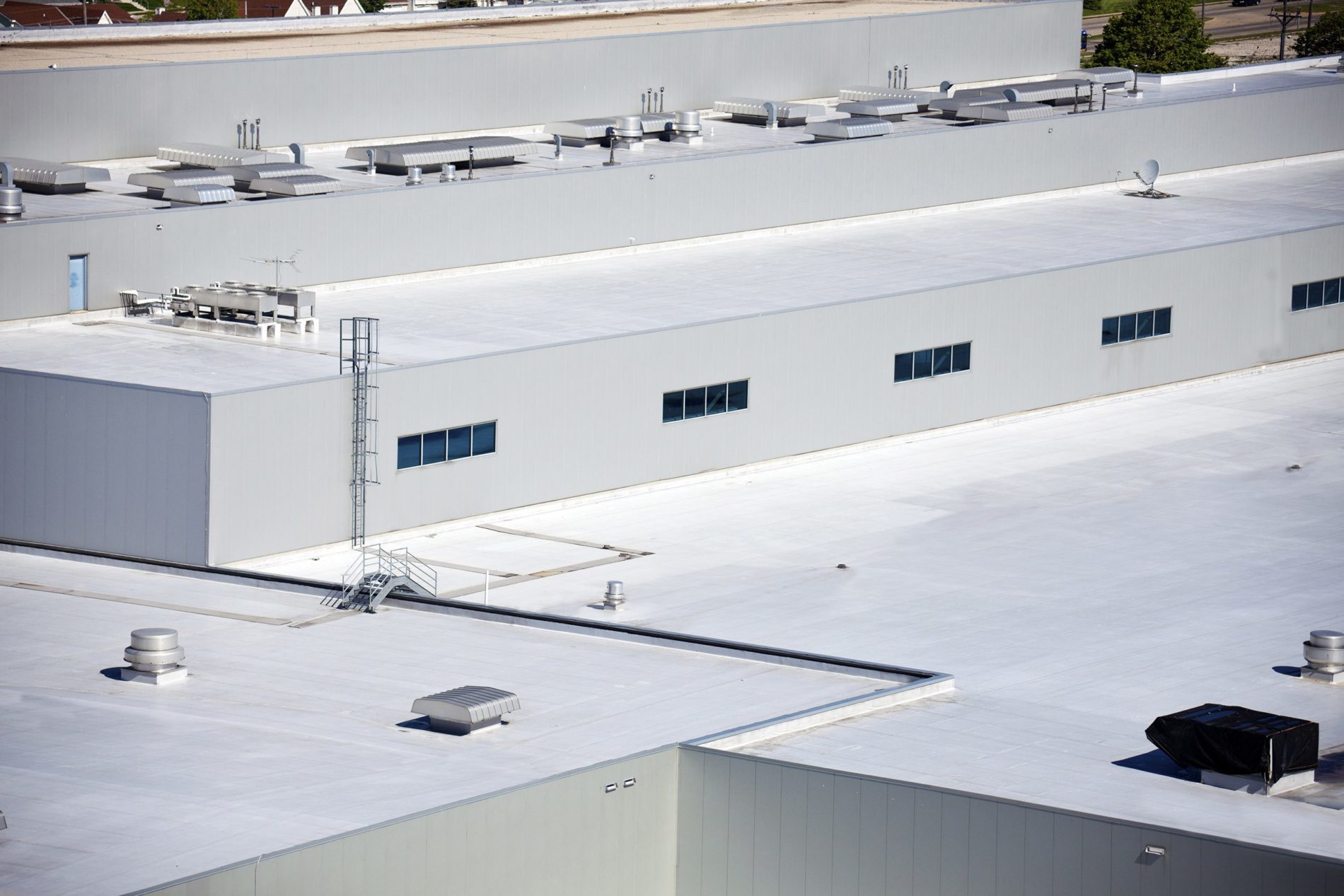
Manufacturing Facility Roofing in Austin, TX
Commercial roofing for manufacturing plants, assembly facilities, and industrial buildings throughout Austin, TX.
Austin's manufacturing sector has been transformed by the semiconductor and advanced electronics investment wave of the past decade, and Samsung's massive semiconductor fabrication complex in Taylor, just northeast of Austin, anchors a high-technology industrial base that has specific and demanding roofing requirements. Manufacturing facilities across the Austin metro, from semiconductor fabs to medical device plants to the automotive manufacturing operations that have recently arrived in the region, operate in a climate that combines Texas heat extremes with the seismic and regulatory environment of a rapidly developing industrial market.
Process equipment on Austin-area manufacturing roofs reflects the semiconductor and electronics industry's intensive cooling and ventilation requirements. Cooling towers supporting cleanroom HVAC systems, precision exhaust handling equipment for chemical process areas, and rooftop chiller units are standard on semiconductor and electronics facilities. These systems cannot be interrupted, cleanroom temperature and humidity control is directly tied to product yield, and even brief interruptions have significant financial consequences. We survey all roof-mounted equipment before mobilizing, build operational constraint maps, and design work sequences that allow reroofing to proceed without affecting any operational system.
Chemical and fume exposure at Austin semiconductor and electronics manufacturing facilities involves acids, solvents, and specialty process gases that off-gas at concentrations capable of degrading standard roofing membranes within years. The specific compounds used in semiconductor fabrication, hydrofluoric acid, sulfuric acid, organic solvents in photolithography processes, are among the most aggressive membrane attack agents in any industrial setting. We obtain facility chemical inventory data and consult with membrane manufacturers' technical teams to specify systems with documented resistance to the relevant compound families. This is not a box-checking exercise, it is a critical specification decision that determines service life.
Central Texas heat is extreme, and Austin manufacturing roofs face surface temperatures that regularly exceed 175 degrees Fahrenheit in July and August. This intense heat affects membrane installation quality during hot weather (adhesive set times change, weld temperatures require adjustment), membrane service life (UV and thermal degradation accelerate), and rooftop worker safety. We adjust installation protocols for Texas summer conditions, schedule heat-sensitive operations for cooler morning hours, and specify membranes with thermal stability ratings appropriate for Central Texas surface temperatures. A membrane specified for a Chicago climate and installed in Austin August heat without protocol adjustments will not achieve its rated service life.
Texas freeze events, demonstrated catastrophically in February 2021, add a cold-weather dimension to Austin manufacturing roofing that was historically underappreciated. Drain lines that are not properly sloped or insulated can freeze and block during rare but severe freeze events, causing catastrophic flooding of production facilities. After 2021, we approach drain design for Austin manufacturing roofs with the same cold-weather rigor we would apply in a northern climate: proper slope to drains, heat trace on exposed drain lines, and overflow scuppers sized to handle drain blockage scenarios. The cost of proper drain design is trivial compared to the cost of a flooded semiconductor fab.
Vibration from semiconductor and advanced manufacturing equipment at Austin facilities is different in character from traditional heavy industrial vibration, it is often higher-frequency and lower-amplitude, but continuous. Vibration isolators on process equipment are standard, but vibration still reaches the building structure through HVAC systems and utility connections. We assess the vibration environment before specifying fastener type and density, and we use fully adhered systems in areas above vibration-sensitive processes to prevent membrane movement from interfering with cleanroom conditions.
Austin's semiconductor and electronics manufacturing facilities often include large skylights or daylight panels over secondary production areas and support spaces. These elements require special attention in Texas: UV degradation of polycarbonate and acrylic glazing is accelerated in Central Texas solar conditions, and thermal expansion in summer heat can stress frame seals. We specify replacement glazing with UV stabilizers appropriate for Texas exposure, and we coordinate replacement scheduling with facility operations to prevent debris intrusion into sensitive areas below.
Travis County's drain regulations and Central Texas storm intensity create a specific drain design environment for Austin manufacturing facilities. The Balcones Fault Zone geology creates rapid runoff that can overwhelm undersized drain systems during intense convective storms. We size drain systems for Austin's design storm intensity per Texas water code requirements, add overflow scuppers at all perimeters, and specify drain field configurations that keep industrial particulate from accumulating to blockage levels between maintenance cycles.
Coordinating reroofing at Austin semiconductor and electronics facilities requires understanding that these operations run continuously, that production interruptions can cost millions of dollars per hour, and that even minor contamination events can compromise product lots worth far more than the roofing contract. Our project management approach for Austin tech manufacturing facilities involves weeks of pre-mobilization planning, detailed phase maps reviewed by facility engineering teams, and daily dry-in commitments backed by on-site project managers who understand the consequences of falling short. We have the track record in this market to substantiate that commitment.
Leak points, drainage, seams, penetrations, edge metal, roof access, and interior risk should be clear before the next roof decision is priced.
Immediate repair, maintenance, coating, recover, and replacement choices should be measured against roof age, moisture risk, tenant disruption, and budget timing.
A site visit is useful when the owner needs a documented roof condition, active leak response, storm review, or a clearer capital plan.