
Hail Damage Roof Repair Service in Austin, TX
Central Texas hail events hit Austin commercial roofs at frequencies above the national average. We assess, document, and repair hail-damaged commercial flat roofs, delivering photo-logged condition reports structured for insurance adjusters and manufacturer warranty representatives.
The June 2024 hail event that swept through Round Rock and Pflugerville into north Travis County dropped quarter-size hailstones across a substantial commercial roof inventory, light industrial, retail, and office buildings along US 79, SH 45, and the IH-35 North frontage roads. That storm generated commercial roof insurance claims that were still being adjusted months later. It was not an anomaly. Austin sits in a hail corridor where documented events occur three to five times per year, with major impact events, stones above 1 inch diameter, arriving every two to four years.
Commercial flat roofs respond to hail differently than residential pitched roofs. TPO membrane impact damage on a 60-mil system from quarter-size hail typically produces measurable denting at hailstone impact points, bruising at insulation board joints where the membrane flexes over an edge, and, on membranes older than 10 years with UV-degraded surface layers, potential puncture at impacted seam locations. EPDM 60-mil systems show similar bruising patterns. Modified bitumen granule-surfaced systems lose surfacing granules at impact points, exposing the base sheet to UV.
The challenge with commercial hail claims is documentation. An adjuster reviewing a 150,000 sq ft warehouse roof cannot assess every impact point personally. The building owner's position in a coverage dispute depends on a documented inspection that maps impact locations, distinguishes hail damage from pre-existing wear, and provides photo evidence calibrated to an industry-standard damage threshold. That documentation is what we produce.
How We Document Hail Damage on Commercial Roofs
Post-event assessment protocol: Within 48 to 72 hours of a qualifying hail event, we track NWS-reported storm paths and hail size data for Travis, Williamson, and Hays Counties, we can deploy to conduct documented assessments on commercial buildings in the storm track. The assessment is conducted with weather data on hand: the NWS storm report and hail size log for the event date at the specific location.
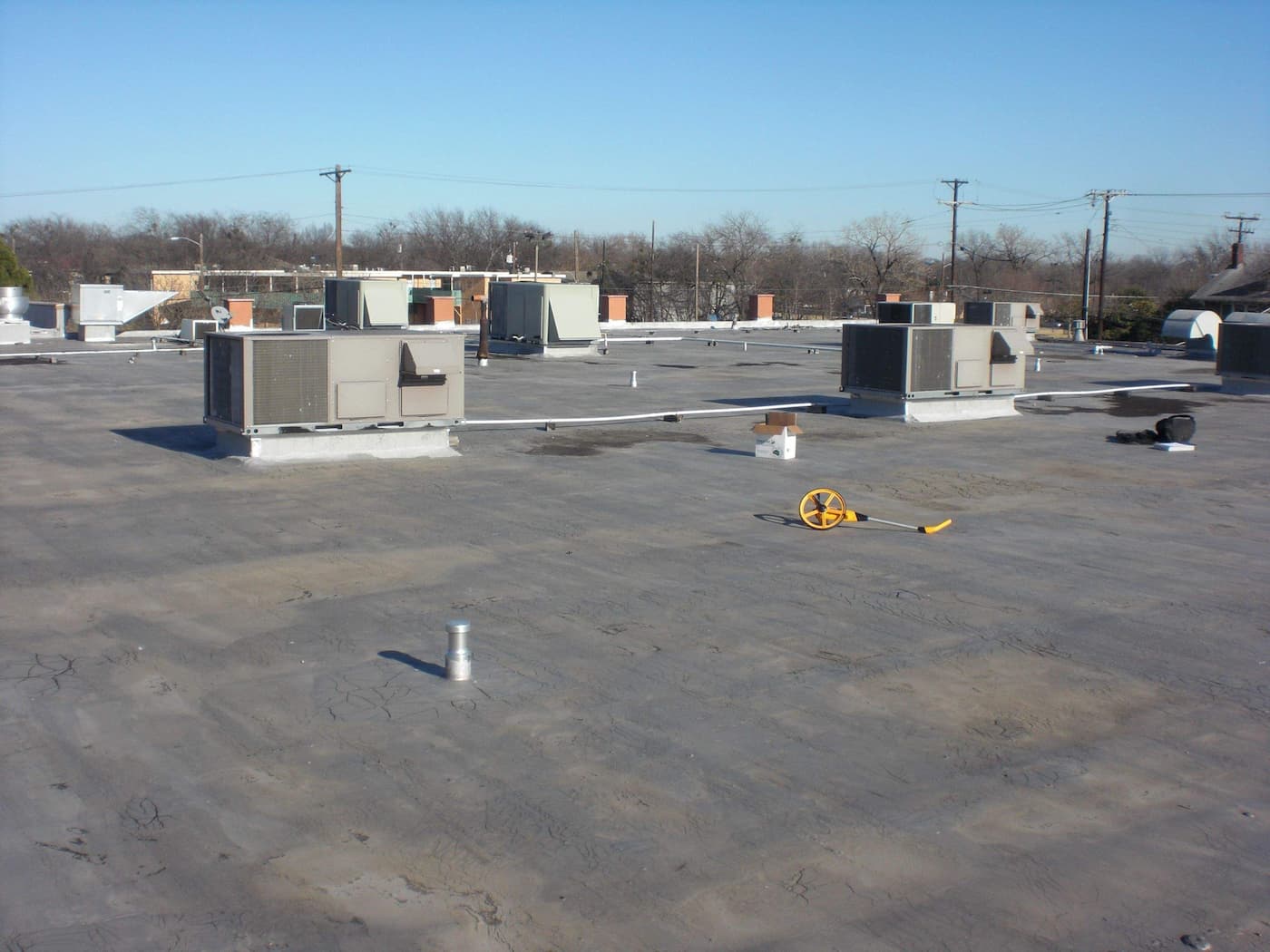
Zone-by-zone documentation: The roof is divided into numbered zones on a pre-drawn diagram. Each zone is walked systematically, with photos taken at all identified impact points. We record impact density (number of impacts per 100 sq ft in affected zones), impact diameter at representative points, membrane condition at impact (dent, bruise, puncture, or seam breach), and photos of pre-existing condition for comparison where visible.
Adjuster-ready report format: The written report includes the zone diagram with impact locations marked, photos keyed by zone number, weather data citation, the inspecting contractor's assessment of which damage is event-related versus pre-existing, and a recommended repair scope with estimated quantities. We do not represent the insured in the claim, we provide the factual documentation that the adjuster needs to work from. The insured's attorney or public adjuster makes the coverage argument.
Repair Scope for Hail-Damaged Commercial Roofs
TPO membrane repair: Impact punctures on TPO are repaired with manufacturer-compatible patch membrane welded over the breach. Seam delamination at impact locations is re-welded where the membrane is otherwise sound, or patched where the base membrane is damaged. Walk pad installation at high-traffic rooftop areas reduces future impact exposure for maintenance crews. We use 60-mil patch material on 60-mil systems and 80-mil on 80-mil systems, mismatched thickness patches are a common subcontractor shortcut we do not take.
EPDM repair: Impact damage to EPDM systems is repaired with fully adhered EPDM patch membrane bonded over the breach with contact adhesive and seam tape. Seam failures at impact locations require stripping in the failed seam and applying new seam tape with appropriate primer. EPDM patch work requires surface cleaning and priming to bond correctly, skipped prep steps produce patches that delaminate within two years.
Modified bitumen: Granule loss on modified bitumen cap sheets from hail impact is documented but often not immediately structural. The concern is long-term: granules protect the base sheet from UV degradation, and a significant granule-loss event on a 15-year-old modified bitumen system accelerates the remaining service life decline. We document granule loss density and include a remaining-useful-life adjustment in the report based on estimated coverage.
Austin Hail History and What It Means for Repair Scope
The documented hail history for Travis and Williamson Counties includes multiple events per year at or above 0.75-inch diameter. Quarter-size (1-inch) and larger events have hit north Travis County and the Round Rock/Pflugerville area in 2024, 2022, and multiple years prior. Buildings in the 78660 (Pflugerville), 78664 (Round Rock), and 78653 (Manor) zip codes have statistically higher hail exposure than buildings in central Austin proper.
For buildings in hail-exposed locations that have already gone through one major storm claim, we typically recommend specification upgrades at replacement or recover: 80-mil TPO instead of 60-mil, or a manufacturer's impact-resistance-rated membrane where available. The incremental cost at installation is small compared to the cumulative cost of repeated repair-and-claim cycles on a 60-mil system over the building's life.
How quickly should I have my roof inspected after a hail event in Austin?
Within 30 days of the event is the practical window for a useful post-event inspection. Before 30 days, the contrast between fresh impact damage and pre-existing wear is clearer. After 60 to 90 days, surface weathering on impact points can make the event-date connection harder to establish in a claim. If you saw hail impact during a recent storm, schedule an assessment promptly, we prioritize post-event work during the weeks following a documented regional event.
My roof was just replaced three years ago. Is hail damage covered under the manufacturer warranty?
Standard manufacturer warranties cover installation defects, not external physical damage. Hail is generally a warranty exclusion. However, some manufacturer programs offer an impact-resistance endorsement for qualifying membrane systems, 80-mil TPO from certain manufacturers carries documented impact-resistance ratings. If your system has that rating, there may be a warranty path. Check your warranty document or call us, we can review the warranty terms and tell you what applies to your specific system.
Can you repair one section of a hail-damaged roof without replacing the whole thing?
In most cases, yes. If the hail impact is localized, quarter-size hail hitting a 50,000 sq ft roof might damage 10,000 sq ft of concentrated zones, targeted repair of the affected zones is appropriate. We document the full roof but repair only the confirmed event-damaged areas. If the undamaged membrane is already near end of life, we document that separately and let the owner make the capital-planning decision independently of the claim.
Schedule a hail damage assessment for your Austin commercial building.
We deploy within 48 to 72 hours of qualifying hail events and deliver adjuster-ready written reports within five business days of the site visit.
Leak points, drainage, seams, penetrations, edge metal, roof access, and interior risk should be clear before the next roof decision is priced.
Immediate repair, maintenance, coating, recover, and replacement choices should be measured against roof age, moisture risk, tenant disruption, and budget timing.
A site visit is useful when the owner needs a documented roof condition, active leak response, storm review, or a clearer capital plan.