
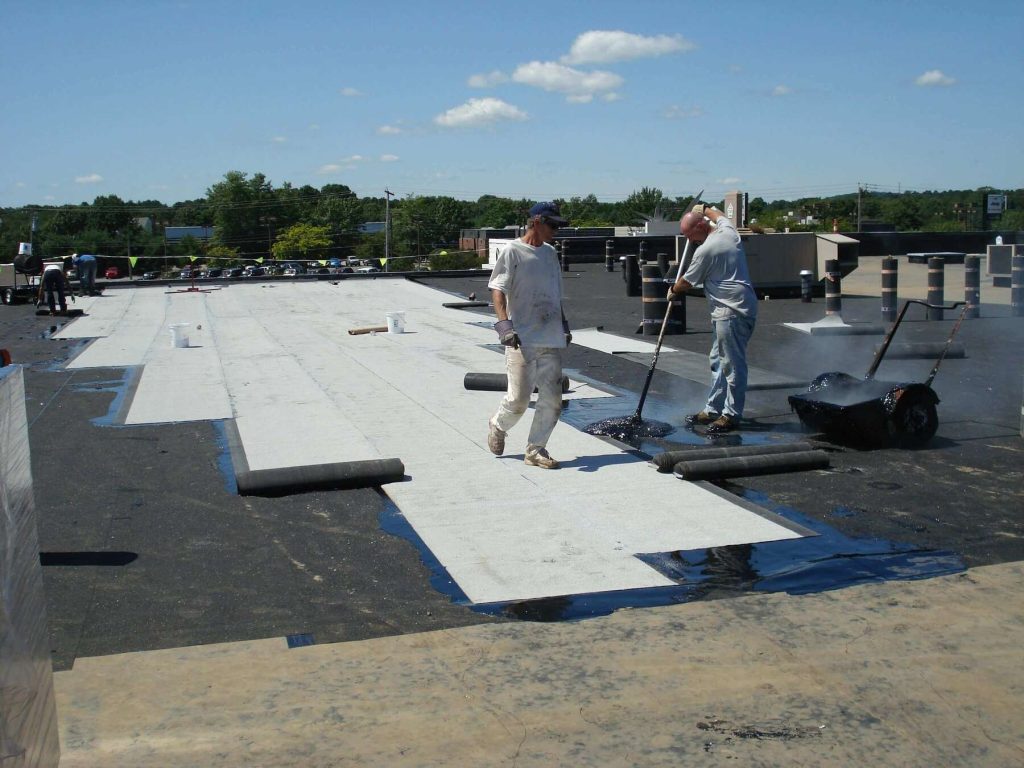
Built-Up Roof (BUR) Systems in Austin, TX
Austin's downtown and near-urban commercial inventory from the 1960s through the 1980s carries a significant built-up roofing install base. We assess BUR condition honestly, scope recover and replacement, and help building owners understand what they have before a capital decision is made.
Built-up roofing, alternating layers of bitumen and reinforcing felt, topped with aggregate or a mineral cap sheet, was the standard commercial flat-roof system for most of the 20th century. In Austin, buildings constructed from the 1950s through the early 1980s on Congress Avenue, the Warehouse District, East 6th Street, and the original North Loop commercial strip were built with BUR systems. Some of those BUR assemblies have been recovered two or three times since original installation; others have been left in place as subsequent layers accumulated.
A BUR system that has been maintained and never had a significant saturation event can still be performing at 40 years of age, the multi-layer assembly has inherent redundancy that single-ply systems do not. However, a BUR system that has sustained moisture infiltration and has saturated felts is a different situation entirely. Saturated felt is structurally compromised, adds dead load to the deck, and is not recoverable by any coating or recover membrane. The only correct scope for saturated BUR is removal and replacement.
Austin's mid-century commercial inventory, particularly the blocks between 5th and 11th Streets on the east side of downtown, the East Austin warehouse blocks near East 6th, and the original Hyde Park and North Loop commercial strip, represents the core of the remaining BUR install base we encounter. We assess these buildings without a predetermined conclusion. If the BUR is dry, performing, and the building owner's capital horizon is 10 years, a coating or targeted repair may be the right call. If the BUR is saturated or the deck is compromised, replacement is the right call regardless of the owner's preference.
How We Assess a Legacy BUR System
Nuclear moisture scanning is the first tool on any BUR assessment where we suspect insulation or felt saturation. A nuclear moisture meter reads hydrogen density in the roofing assembly, wet felts and insulation read distinctly higher than dry material. We walk a grid pattern at 10-foot spacing on suspect areas, mark anomalous readings, and pull physical cores at the highest-reading locations to confirm saturation by direct inspection. This combines the coverage of a non-destructive scan with the ground-truth of a physical sample.
Core samples from a BUR system tell us the felt and insulation condition, the number of ply layers, and the deck condition at the pull location. On a 1970s Austin building, we commonly find two or three layers of felt and gravel topped by a mod-bit recover cap sheet from the 1990s, the building has been reroofed in place. The total assembly dead load matters for structural review if we are recommending yet another recover layer.
Surface condition assessment on a gravel-surfaced BUR looks at aggregate embedment, alligatoring of the base bitumen between aggregate stones, fishmouthing at felt laps, and condition of flashings at parapet walls, drains, and penetrations. Significant alligatoring of exposed bitumen indicates UV degradation of the base bitumen, the aggregate has shifted or been displaced, leaving bitumen exposed. This is a maintainable condition at low severity and an end-of-life indicator at high severity.
BUR Recover Options for Austin Legacy Buildings
A BUR recover places a new single-ply membrane, typically TPO, EPDM, or a mod-bit cap sheet, over the existing BUR assembly. The recover eliminates tear-off cost and avoids the structural and logistical complexity of removing a 40-year-old multi-layer assembly from a building that may not have been designed to accommodate the demolition loading pattern.
BUR recover eligibility requirements are strict: insulation and felts must be predominantly dry (confirmed by core sampling and nuclear scan), the existing assembly must be mechanically sound, and the total dead load of existing assembly plus recover must be within the deck's structural capacity. On mid-century Austin downtown buildings, we pull the original structural drawings where available to confirm dead-load capacity before recommending a recover. If drawings are unavailable, we coordinate with a structural engineer for an in-place load assessment.
If a BUR recover is viable, we specify the recover assembly including a venting base sheet in cases where the existing BUR has limited vapor transmission, trapping moisture vapor under an impermeable recover membrane can cause blistering. Vented recover base sheets are a standard precaution on BUR recover projects in Austin's humid subtropical climate.
Full BUR Replacement on Austin Downtown and Mid-Century Buildings
Full BUR replacement, tear-off, deck inspection and repair, new insulation and membrane, is the right scope for any building where moisture core sampling shows saturation above 25 percent of the sampled area or where deck inspection reveals structural compromise. On some downtown Austin properties, we find that the BUR has been leaking for years and the deck panels beneath the worst zones have corroded to a point where deck replacement is part of the scope.
Tear-off and disposal of a multi-layer BUR system on a downtown Austin property requires careful planning. Old BUR material, multiple layers of felt and bitumen plus aggregate, is heavy and generates significant disposal volume. Dumpster staging on a downtown Austin block requires right-of-way permits from Austin Transportation. We handle this as a standard part of downtown project logistics.
After tear-off and deck inspection, the replacement system is typically TPO on a new insulation stack designed to current IECC 2021 energy code minimums, a significant improvement over the no-insulation or minimal insulation that many 1960s-70s BUR systems were installed over. The energy code upgrade embedded in a BUR replacement project is a documented capital improvement for building owners pursuing LEED EBOM certification or ENERGY STAR recertification.
Can a built-up roof be coated instead of replaced?
If the BUR is dry and the surface is sound, a fluid-applied silicone or acrylic coating can extend service life 10 to 15 years at lower cost than replacement. The prerequisites are strict: no saturated insulation or felts, no open seams or fishmouthed laps, and a clean, primed surface that will accept adhesion. We assess coating eligibility as part of every BUR evaluation and recommend it where the substrate genuinely supports it. We do not recommend coating to defer a replacement that will cost more to postpone than to execute.
How much dead load does a built-up roof add to the structure?
A standard gravel-surfaced BUR system runs 8 to 12 pounds per square foot. Multiple BUR layers plus a mod-bit recover cap sheet can reach 18 to 25 lbs/sq ft. This matters when specifying a new recover layer, a mid-century Austin building designed to the 1960s or 1970s UBC may have limited additional dead-load capacity. We pull structural drawings where available and coordinate with a structural engineer where the dead-load question is unresolved before making a recover recommendation.
Are there any historic preservation requirements for downtown Austin BUR replacements?
Some buildings in the downtown Austin historic district or on the National Register of Historic Places have review requirements for exterior modifications, which may include roofing. The City of Austin's Historic Preservation Office reviews projects on locally designated landmarks. We identify the historic status of any downtown property before designing the scope and flag any potential review requirement to the building owner before the permit application.
Get an honest BUR assessment for your Austin legacy building.
We use nuclear moisture scanning and physical core sampling to characterize what is actually in the assembly before making a recommendation. You will get a written report with data, not a sales call for the highest-cost option.
Leak points, drainage, seams, penetrations, edge metal, roof access, and interior risk should be clear before the next roof decision is priced.
Immediate repair, maintenance, coating, recover, and replacement choices should be measured against roof age, moisture risk, tenant disruption, and budget timing.
A site visit is useful when the owner needs a documented roof condition, active leak response, storm review, or a clearer capital plan.