
Airport Terminal & Aviation Facility Roofing in Austin, TX
Airport terminal and aviation facility roofing in Austin, TX starts with an understanding that these structures can't follow a standard commercial timeline. Austin-Bergstrom International Airport (AUS), rapidly expanding Texas hub with multiple terminal expansions underway to accommodate explosive growth, operates around the clock, and every work access point, material lift, and crew deployment must be coordinated with the airport's facilities department, the FAA Part 139 safety program, and in some cases TSA security protocols. We build that coordination into the project scope before the contract is signed, not after mobilization.
AUS is in the middle of a multi-year, multi-terminal expansion, new concourses, hotel structures, and expanded cargo pads that all require large-area roofing contractors with aviation-protocol experience.
Secondary and Reliever Airports Serving Austin:
- Georgetown Municipal Airport (GTU), general aviation north of Austin
- Austin Executive Airport (EDC), general aviation and business charter northeast of Austin
The roofing systems on airport terminals and aviation support structures carry requirements beyond standard commercial membranes. Jet blast exposure on airside roofs requires membrane adhesion and ballast specifications that exceed what you'd specify for a comparable logistics building. HVAC systems on terminals are denser and heavier than standard commercial, requiring a higher number of curbed penetrations and more frequent flashing maintenance touchpoints. Terminal roofs often span long, flat expanses with minimal slope, which means drainage design is critical and ponding tolerance is near zero. We've done this work, and we don't learn those lessons on your project.
Aviation-adjacent commercial roofing, cargo facilities, rental car centers, FBO hangars, aircraft maintenance facilities, hotel structures on airport campuses, presents a different set of challenges than the terminal building itself, but the airport coordination requirement doesn't go away. Our crews understand that badging and security access at any part of an airport campus is non-negotiable and is planned for, not discovered onsite.
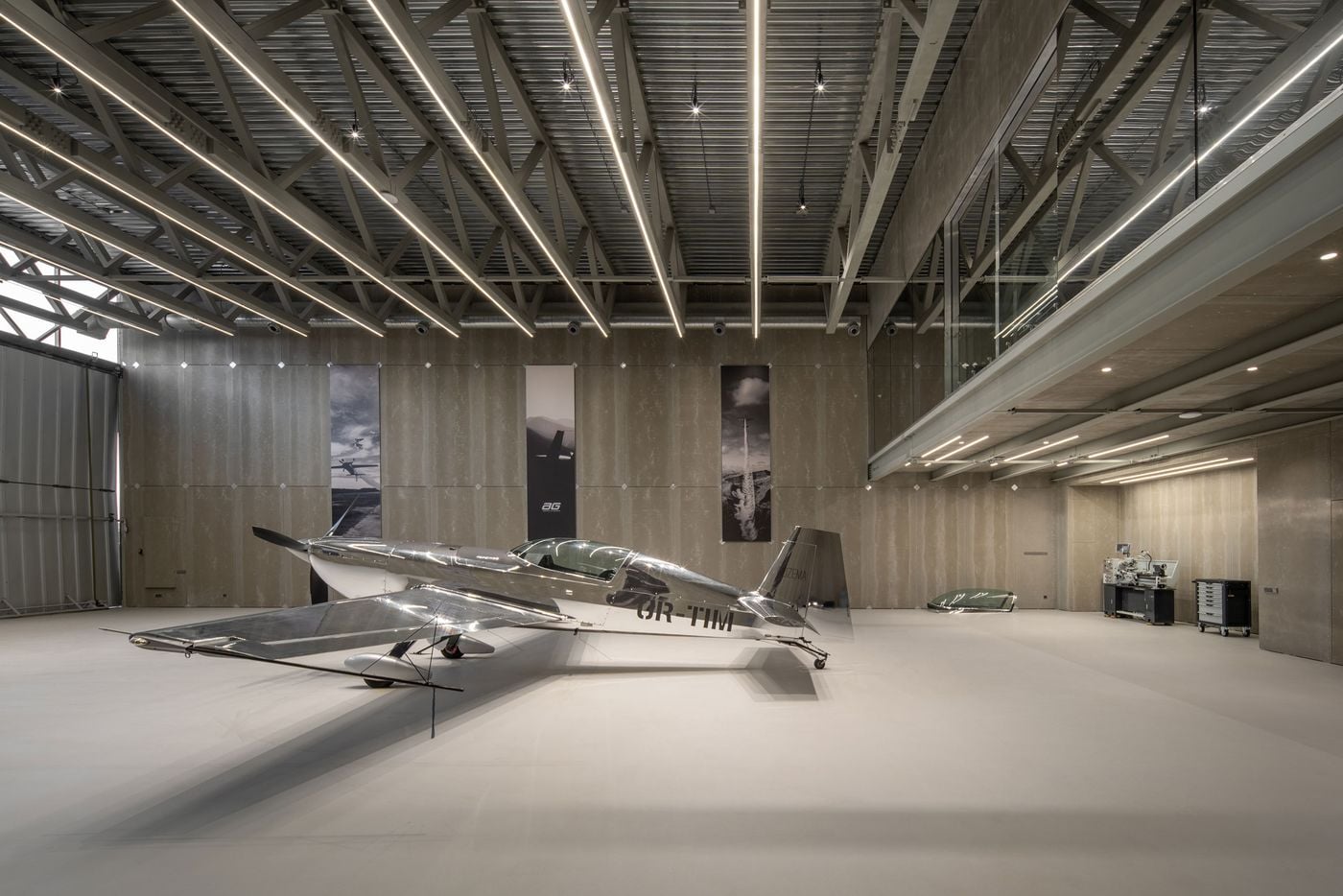
For general aviation facilities, FBOs, private hangars, and reliever airport structures, the security protocols are less intensive but the building type is often more demanding. High-bay hangar structures with large clear-span roofs require specific fastening patterns and seam geometry to handle the wind uplift loads these buildings generate. We spec and install those systems in Austin and throughout TX.
Airport & Aviation Roofing Questions
We work with the airport facilities department and FAA Part 139 coordinator to develop a phased work plan approved by airport operations. Material deliveries, crane lifts, and any work near airside areas are scheduled during approved windows and coordinated with the FAA NOTAM process if required. We've done this at multiple airports and it's a standard part of our project setup, not an exception.
Most terminal re-roofing in Austin uses a TPO or PVC single-ply membrane on a tapered insulation system designed to improve drainage and address ponding. For new high-bay aviation structures and hangars, standing seam metal is often specified. The selection depends on the existing deck, load capacity, and operational constraints, we develop a spec after walking the roof with your facilities engineer.
Terminal HVAC density is significantly higher than standard commercial. Our pre-project survey documents every penetration, curb height, and mechanical clearance before we develop the work plan. Flashing details for oversized equipment curbs and complex through-penetrations are engineered individually, we don't use standard residential-pattern flashing details on aviation structures.
Yes, with appropriate badging and in full coordination with airfield operations. Airside work requires a higher level of pre-planning and crew credentialing, which we factor into the bid timeline. We do not mobilize crew members without confirmed airside authorization, that's a baseline requirement we enforce, not a favor we ask.
Yes. General aviation hangar roofing, whether for a single-bay private hangar or a multi-unit FBO complex, is a regular part of our commercial project mix in Austin. High-bay hangars with wide-flange steel or pre-engineered building systems require roofing contractors who understand those structures' specific uplift and thermal movement characteristics. We do.
Airport terminal and aviation facility roofing in Austin, TX, Austin-Bergstrom International Airport and surrounding general aviation and cargo facilities.
Austin's warehouse inventory, from Del Valle's SH 130 logistics corridor to the East Austin industrial pockets, has added millions of square feet in the last decade. We scope, replace, and maintain large-deck commercial flat roofs sized for the operational demands of distribution and storage use.
Austin's warehouse market expanded significantly when SH 130 opened a viable alternative to I-35 for freight movement through the metro. The Del Valle corridor south of Austin-Bergstrom International Airport has absorbed large-format logistics and fulfillment development, tilt-wall buildings in the 200,000 to 500,000 sq ft range with TPO or modified-bitumen flat roofs on open steel deck. These buildings are now hitting the 7-to-12-year maintenance window where the first membrane decisions need to be made.
East Austin's older warehouse cluster, Airport Boulevard, Springdale Road, and the industrial pockets east of I-35 between MLK and 51st, is a different inventory profile: pre-2000 buildings with built-up roofing (BUR) or modified-bitumen systems that have been patched repeatedly and are often past the recover threshold. Full replacement with TPO is the correct scope on most of these buildings, but the scope decision depends on insulation condition data, not age alone.
Warehouse roofing in the Austin market has two climate variables that drive scope decisions. First, UV load: Austin's high-UV environment degrades uncoated modified bitumen faster than manufacturers' published timelines assume, particularly on roofs with minimal shade and maximum southern exposure. Second, the SH 130 corridor's exposure category, open terrain adjacent to the highway, pushes wind-uplift requirements into Exposure C for many buildings, which tightens fastener pattern density requirements and affects parapet attachment details.
Large-Deck Roof Replacement in the Del Valle Corridor
Del Valle's SH 130 logistics buildings are some of the largest single-roof-footprint commercial projects we scope. A 400,000 sq ft warehouse has a roof that requires phased tear-off and dry-in sequencing, opening the entire deck simultaneously is never the right plan. We divide large decks into 20,000 to 30,000 sq ft production zones, complete tear-off, insulation placement, and TPO membrane installation with same-day dry-in in each zone before moving to the next.
Tilt-wall construction dominates this corridor. The parapet-to-wall interface on tilt-wall panels is a documented chronic leak point, thermal movement at the metal coping cap degrades sealants on a 5-to-8-year cycle regardless of initial installation quality. Our scope walks on Del Valle tilt-wall buildings always include systematic documentation of coping joint condition, through-wall flashing condition, and interior drain leader pipe access. These details drive repair-vs-replace decisions independent of membrane condition.
Loading dock roof overhangs and exterior canopies on large warehouse buildings need separate scoping from the main field. Dock canopies have different drainage geometry, different wind exposure at the building edge, and in some buildings, different deck material than the main field. We scope them separately and include them in the same project when it is logistically practical to sequence the work.
East Austin Warehouse Inventory
The East Austin warehouse cluster predates the SH range from 1970s concrete-frame with aggregate-surfaced BUR systems to early-2000s steel-frame with modified bitumen. The 1970s and 1980s buildings in this cluster are the most common full-replacement candidates, BUR systems past their expected service life, insulation saturated beyond the recover threshold, and deck condition that requires inspection ports before any scope is finalized.
Austin's development pressure on East Austin has added an ownership transition layer: buildings purchased for redevelopment are sometimes in limbo, the owner knows redevelopment is 3 to 7 years out and does not want to invest in full replacement. In those cases, we scope minimum-intervention repairs to keep the building dry through the hold period rather than recommending full replacement that will be demolished. That is the honest scope for the situation.
Operating Constraints on Warehouse Roofing
Active warehouse operations create constraints that standard commercial roofing projects do not face. Forklift traffic through loading bays means crane positioning cannot block dock access without shutting down inbound freight, unacceptable to a 24/7 fulfillment operation. Material staging on the roof must account for live load limits on open steel deck. Roof access during production cannot coincide with rack replenishment operations directly below the tear-off zone.
We develop a construction logistics plan for every active-warehouse project before mobilization: dock access windows, roof staging zone load limits, daily production zone mapping shared with warehouse management the morning before each shift, and a communication protocol for the facility coordinator. The roof crew does not make operational decisions, the plan sets the rules before the project starts.
Can a warehouse roof be replaced while the building is in full operation?
Yes, with a phased sequence and a written logistics plan. We work in zones sized so that no section is open overnight and no zone's production footprint blocks dock access or interior aisles below. The sequence requires daily coordination with facility management, but full closure is not necessary on any warehouse project we have scoped in the Del Valle or East Austin corridors.
What is the right membrane for a large Austin warehouse?
TPO 60-mil is the standard specification for most Austin warehouse replacements, white reflective surface, heat-weldable seams, 20-year NDL warranty path, and good performance in Austin's UV environment. 80-mil is worth the additional cost per square for buildings near the SH 130 corridor with Exposure C wind classification or documented hail history. Modified bitumen recover is sometimes appropriate for buildings with dry insulation and BUR base that are not yet at the replacement threshold.
Does the City of Austin or Travis County require permits for large warehouse re-roofing?
Yes. The City of Austin Development Services Department requires a permit for commercial re-roofing projects. Del Valle properties may fall under Travis County jurisdiction rather than City of Austin jurisdiction depending on the parcel, we confirm the permitting authority during pre-construction setup and pull the applicable permit. Permit timelines in Travis County have run 10 to 20 business days for large commercial projects.
Get a written scope for your Austin warehouse roof.
Our project managers cover the Del Valle corridor, East Austin, and all Travis and Williamson County industrial submarkets. We deliver a written condition report with moisture core data within five business days of the site visit.
Leak points, drainage, seams, penetrations, edge metal, roof access, and interior risk should be clear before the next roof decision is priced.
Immediate repair, maintenance, coating, recover, and replacement choices should be measured against roof age, moisture risk, tenant disruption, and budget timing.
A site visit is useful when the owner needs a documented roof condition, active leak response, storm review, or a clearer capital plan.