
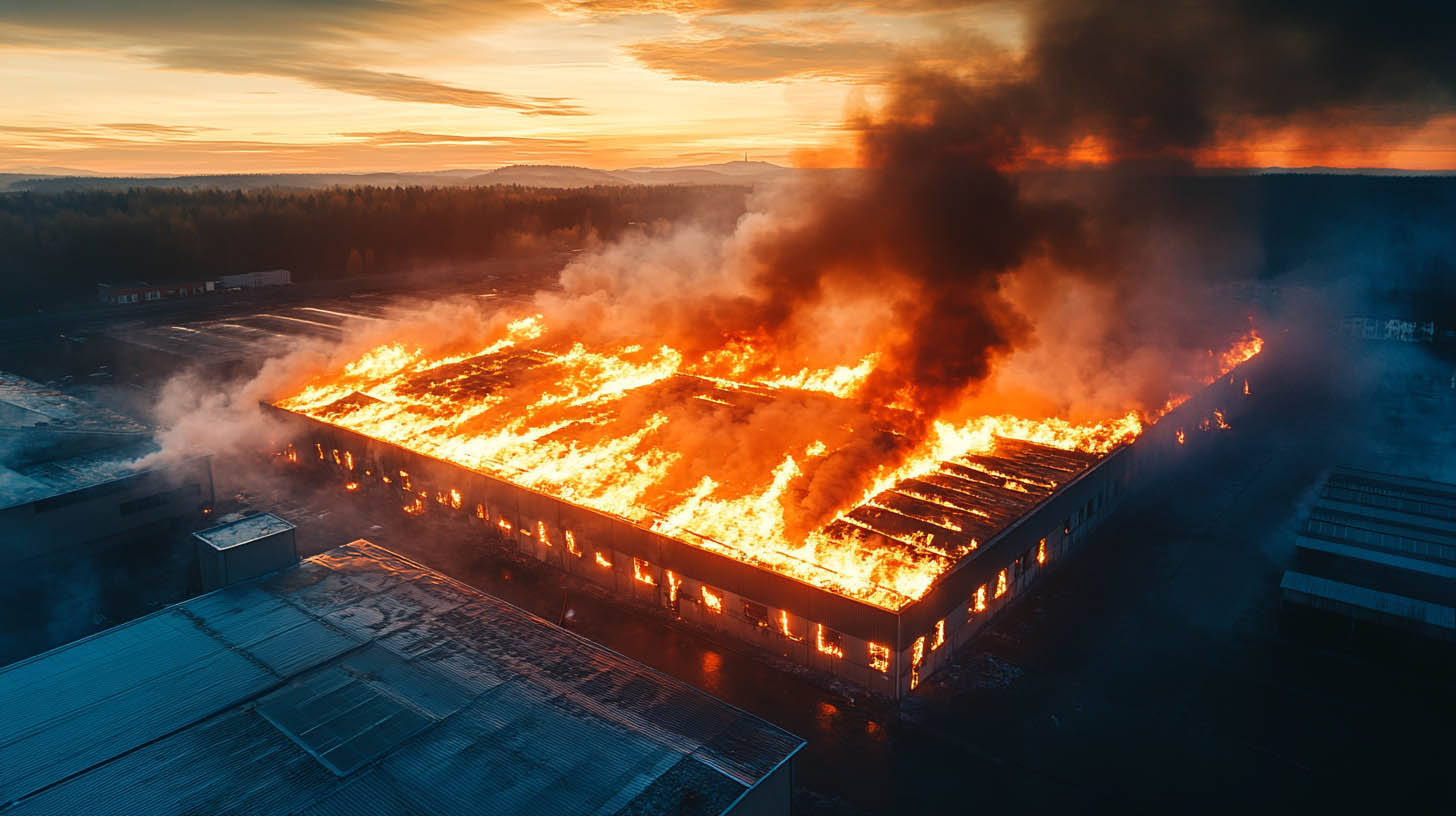
Fire Damage Roof Repair in Austin, TX
Post-fire assessment and repair on Austin commercial flat roofs, damage documentation, structural coordination, and warranted membrane repair after fire and smoke events.
Fire damage on commercial flat roofs presents a fundamentally different assessment challenge than storm or leak damage. The primary concern after any commercial building fire in Austin is structural integrity, the Austin Fire Department's post-fire inspection process and the City of Austin Development Services Department building official make the safety and occupancy determination. No roofing work proceeds on a fire-affected building until the structure has been cleared by the relevant authorities.
Once the building has been cleared, the roof assessment distinguishes between zones of direct thermal damage and zones affected by fire suppression water. Direct fire or heat damage to a commercial roof assembly, membrane carbonization, insulation melt-through, deck deformation, is typically concentrated near the fire origin and its travel path. Fire suppression water damage to the roof assembly is often more widespread: suppression hoses discharge significant water volume onto and through the roof, and water used to fight the fire may enter the assembly through heat-compromised membrane sections across a much larger area than the burned zone.
Austin's commercial building stock includes structures from every era of the city's growth. Older commercial buildings in East Austin, South Congress, and the industrial areas near the airport may have roofing assemblies with materials that present specific concerns in post-fire assessment, legacy BUR systems with coal-tar pitch, asbestos-containing materials in older insulation or vapor barriers, and modified bitumen systems with embedded fiberglass. We document material concerns that arise in the assessment and flag them for the appropriate remediation specialists before roofing work proceeds.
Fire Damage Assessment Sequence
Authority clearance first: We confirm with the Austin Fire Department and City of Austin Development Services that the structure has been cleared for entry before any site assessment. We do not enter a posted or restricted structure regardless of urgency.
Thermal damage zone documentation: We document the extent of direct heat damage by zone, carbonized membrane, melted or collapsed insulation, deformed or compromised steel deck. Each zone is photographed and mapped to the roof diagram. The thermal damage zone boundary is where membrane or insulation shows visible heat-induced change in material properties.
Suppression water damage zone: Outside the thermal damage zone, we assess suppression-water-affected membrane and insulation. Fire suppression water enters through heat-compromised sections and through any membrane breach created during firefighting access. Infrared thermography documents the extent of wet insulation outside the direct burn zone.
Adjacent membrane condition: Membrane sections that were not directly exposed to heat may have been affected by radiant heat, TPO and EPDM membranes within 10 to 20 feet of an active fire can soften, and the cooling cycle can produce distortion or seam separation. We assess adjacent sections in detail, not just the obviously burned zone.
Repair Scope by Damage Category
Direct thermal damage zone: Full tear-off and replacement of all membrane, insulation, and in cases of deck deformation, structural deck in the burned zone. The boundary of the replacement zone extends to the first line of undamaged membrane and insulation outside the burn area, with a minimum 3-foot overlap into undamaged material on all sides.
Suppression water damage zone: If infrared and core sampling confirm significant insulation saturation in the suppression water zone, insulation replacement is required in those areas before recovering with new membrane. Wet insulation adjacent to a fire zone may also have smoke and suppression-agent contamination that makes it unsuitable to leave in place.
Adjacent membrane repair: Heat-distorted seams and membrane sections adjacent to the burn zone are repaired, re-welded or re-adhered per membrane type, or replaced if the distortion has compromised the membrane thickness below minimum spec.
Penetration and flashing rebuild: Any penetration or flashing within or adjacent to the burn zone is assumed to be compromised and is re-flashed in the replacement scope. Fire suppression thermal shock can crack sealants and debond flashings that appear intact visually.
Documentation for Insurance and Code Compliance
Post-fire roofing repair on Austin commercial buildings may require a building permit, the City of Austin Development Services Department typically requires permit issuance for repairs that exceed a defined scope threshold, and post-fire work often qualifies regardless of area. We pull the permit as part of project setup.
Our documentation package for fire-damage repair includes the pre-repair assessment report with zone mapping and photographic evidence, the repair scope with material specifications, and the closeout package with permit final and manufacturer warranty documentation for any warranted repair areas. The documentation format is designed to support the building owner's insurance claim submission and to satisfy the code compliance requirements for the repair permit.
Can a commercial roof be repaired after a fire, or does the whole thing need to be replaced?
It depends on the extent of thermal and water damage. A contained fire that affected a limited roof zone, say, an HVAC unit fire that damaged a 20-foot radius of membrane, can often be repaired with a targeted replacement of the burned zone and adjacent suppression-water-affected areas. A fire that traveled through the building and compromised large sections of the structural deck typically requires full replacement in the affected zones. The assessment determines which scope applies.
How do I coordinate roof repair with my insurance adjuster after an Austin commercial building fire?
Most fire claims involve a dedicated adjuster or independent adjuster who will want a scope from a qualified contractor before approving repair costs. Our assessment report provides the documented damage inventory and the repair scope with unit quantities. We coordinate access for the adjuster's independent inspection and provide our report in a format they can use for their scope comparison. We do not advise on coverage positions.
Does Austin require a building permit for post-fire roof repair?
In most cases, yes. The City of Austin Development Services Department requires permits for commercial roofing repairs above a defined threshold, and post-fire repairs almost always qualify. Permit requirements vary by scope and municipality, for buildings outside Austin city limits (Round Rock, Cedar Park, Pflugerville), we confirm the applicable requirement with the local building official. We handle permit acquisition as part of project setup.
Schedule a post-fire roof assessment for your Austin commercial building.
We coordinate with the AHJ on access clearance, document the full damage picture, and produce a repair scope that supports your insurance submission.
Leak points, drainage, seams, penetrations, edge metal, roof access, and interior risk should be clear before the next roof decision is priced.
Immediate repair, maintenance, coating, recover, and replacement choices should be measured against roof age, moisture risk, tenant disruption, and budget timing.
A site visit is useful when the owner needs a documented roof condition, active leak response, storm review, or a clearer capital plan.